
The Omega Rebalance: Redefining Essential Fatty Acid Nutrition
Few areas of nutrition have generated as much enthusiasm, and as much confusion, as omega-3 and omega-6 essential fatty acids. For years, we’ve been told to eat more omega-3s and avoid omega-6s, leaving many people confused about which fats are actually healthy. The truth is both. Both omega-3s and omega-6s are essential nutrients; they help build cells, keep organs functioning, and allow different parts of the body to communicate effectively.
As interest in these essential fatty acids continues to grow, consumers are also seeking more sustainable ways to obtain them. Today, fish remains the dominant source of omega-3 ingredients, with krill representing a smaller but established marine source. However, both rely on marine ecosystems with finite resources and face growing questions around long-term supply and sustainability. These challenges are driving interest in a broader range of plant- and algae-based alternatives, including microalgae, and emerging oilseed crops such as Buglossoides arvensis. While these sources currently represent a relatively small share of the overall omega-3 supply, their availability, and scientific evidence base are expanding. The future of fatty acid nutrition is not simply about adding more omega-3s, but about creating smarter, more diverse and sustainable strategies that optimize fatty acid balance, support metabolic health, and help meet the nutritional needs of a growing global population.
This evolving perspective comes at a time when interest in omega-3 nutrition continues to grow worldwide. The global omega-3 fatty acids market was valued at approximately 2.95 billion USD in 2025 and is projected to reach 5.72 billion USD by 2034, reflecting an annual growth rate of 7.6% (1). Consumers are increasingly seeking nutritional solutions that support cardiovascular, cognitive, metabolic, and healthy aging while also demanding products that are sustainable, traceable, and environmentally responsible (2). These expectations have accelerated interest in alternatives to traditional marine-derived omega-3s, including innovative plant- and algae-based sources that can help meet global demand without increasing pressure on marine ecosystems (3, 4).
Beyond the Omega-3 vs. Omega-6 Debate
Both omega-3s and omega-6s are essential nutrients that cannot be made or stored in the human body; they must be provided through the diet (5). The physiological impact of these fatty acids has many variables that impact the balance between inflammatory and pro-resolving pathways (6, 7). Omega-3s and omega-6s together serve as structural components of cell membranes, regulate membrane fluidity, influence receptor signaling, support neurological development, and provide substrates for hundreds of bioactive lipid mediators that coordinate immunity, metabolism, tissue repair, and cellular communication (8, 9).
This distinction is increasingly important because inflammation itself is no longer viewed simply as a pathological process to suppress. Contemporary immunology recognizes inflammation as an essential biological response that must ultimately transition into an active process of resolution. This process is orchestrated by specialized lipid mediators derived from both omega-6 and omega-3 fatty acids, including lipoxins, resolvins, protectins, and maresins, which modulate inflammation, promote tissue repair, and restore physiological homeostasis (10, 11).
As our understanding of inflammation biology continues to evolve, so too must our approach to essential fatty acid nutrition. The future lies not in framing omega-6 and omega-3 fatty acids as nutritional adversaries, but in understanding how they work together to maintain metabolic resilience, immune function, and long-term health.
How We Lost Balance: The Changing Landscape of Essential Fatty Acid Nutrition
Essential fatty acids have been part of the human diet throughout evolution, yet the quantity, diversity, and sources of these fats have changed dramatically over the past century.
Anthropological evidence suggests that ancestral hunter-gatherer diets supplied a broad spectrum of fatty acids from wild plants, game animals, nuts, seeds, and marine foods (12). Although precise dietary patterns varied substantially by geography, season, and food availability, research suggests that ancestral diets generally provided a more balanced intake of omega-6 and omega-3 fatty acids than modern Western diets (13). Importantly, these diets also contained higher levels of fiber, antioxidants, polyphenols, and micronutrients that collectively influenced lipid metabolism and inflammatory responses.
The rise of agribusiness marked a turning point in global dietary fat consumption. Technological advances in agriculture, solvent extraction, food processing, and food preservation enabled the large-scale production of inexpensive vegetable oils derived from soybean, corn, sunflower, safflower, and cottonseed crops. These oils rapidly became foundational ingredients in processed foods because of their affordability, versatility, oxidative stability, and ability to extend product shelf life. As lifestyles became increasingly fast-paced throughout the latter half of the twentieth century, consumer demand shifted toward foods that were convenient, portable, inexpensive, and ready-to-eat (14).
Consequently, dietary patterns shifted away from traditional meals prepared from minimally processed ingredients toward more energy-dense, highly processed foods with reduced nutrient diversity and lower intakes of seafood, fruits, vegetables, legumes, and other whole foods that naturally provide omega-3 fatty acids and other essential nutrients (15).
This transformation substantially altered the composition of dietary fats in food sources. Consumption of linoleic acid increased, while intake of oily fish and other sources of preformed EPA and DHA remained relatively low in many populations (16, 17). As early as the 1990s, research highlighted this shift in dietary fatty acid intake and the widening gap between omega-6 and omega-3 consumption. Western dietary patterns had shifted dramatically, with estimated omega-6:omega-3 ratios reaching approximately 20:1 in some populations (18). These observations contributed to the influential rationale that a high dietary omega-6:omega-3 ratio could favor inflammatory signaling and contribute to chronic inflammatory conditions (19). However, subsequent research has shown that the relationship between dietary omega-6 intake and inflammation is considerably more complex than the ratio alone (20, 21).
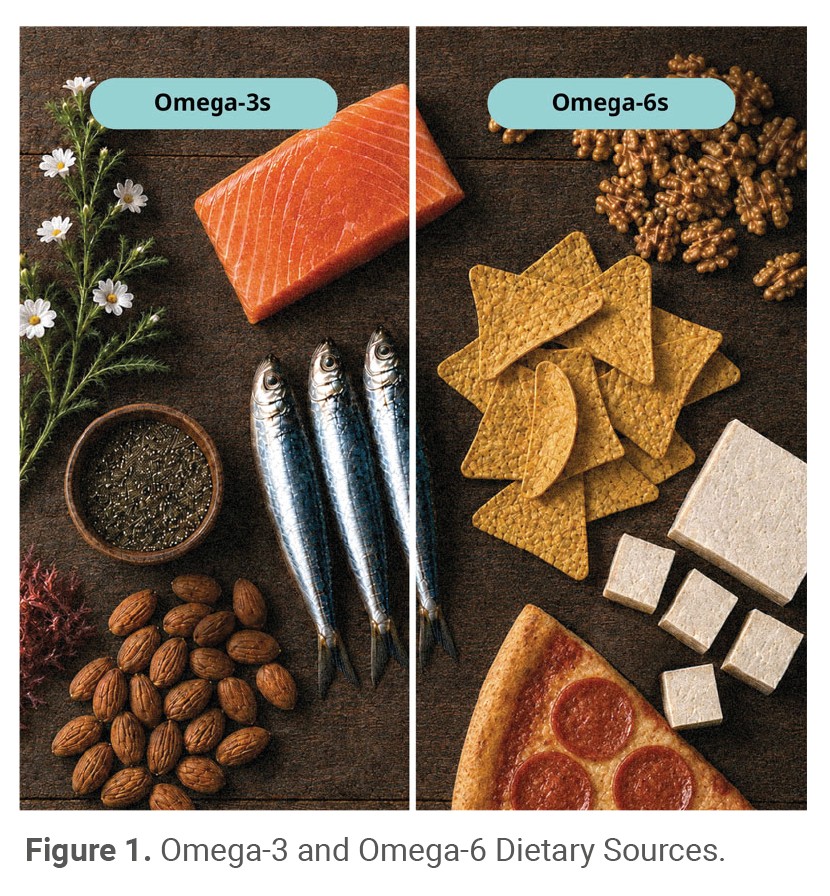
Omega-6s are Not All Bad
Perhaps the most important advance surrounding omega-6s, is the recognition that inflammation is not inherently harmful, it is essential. Acute inflammation protects against infection, removes damaged tissue, and initiates repair (22, 23). The greater concern is when inflammation fails to resolve, potentially contributing to chronic disease.
Many investigators now argue that the modern dietary challenge is not simply “too much omega-6s,” but of disrupted essential fatty acid homeostasis. The widespread replacement of diverse whole foods with refined ingredients, coupled with insufficient intake of long-chain omega-3 fatty acids, has altered the availability of substrates required for the coordinated production of lipid mediators that regulate immune function and inflammation resolution.
This evolving perspective shifts the conversation away from assigning blame to individual fatty acids and toward understanding the broader dietary patterns that influence metabolic resilience. It also raises an important question: if omega-6 fatty acids are essential for normal physiology, have we been too quick to label them as the nutritional villain?
Equally important, arachidonic acid (omega-6) is not solely a precursor to pro-inflammatory mediators. It is also used to produce lipoxins, which help initiate the resolution phase of inflammation (24). As the inflammatory response progresses, the production of signaling molecules shifts away from those that initiate inflammation and toward those that actively promote its resolution. Lipoxins, together with EPA- and DHA-derived specialized pro-resolving mediators (SPMs), including resolvins, protectins, and maresins, help limit further immune cell recruitment, enhance the clearance of cellular debris, support tissue repair, and promote the restoration of tissue homeostasis (25, 26).
This evolving understanding has reframed the role of essential fatty acids in human health. Rather than viewing omega-6 and omega-3 fatty acids as opposing forces, they are now recognized as complementary substrates that support different phases of a healthy inflammatory response. The nutritional goal is therefore not to eliminate omega-6 fatty acids, but to ensure an adequate supply of both omega-6 and omega-3 fatty acids providing the body with the lipid mediators needed to appropriately initiate, regulate, and successfully resolve inflammation.
While omega-6 fatty acids play essential roles in both initiating and resolving inflammation, the Western diet still provides far more omega-6s than omega-3s. The next question then becomes: How can we support dietary omega-3s supplementation in a way that is both effective and sustainable?
The Next Generation of Omega Nutrition: Bridging Agricultural Innovation and Human Health
As the demand for omega-3 nutrition continues to grow, the future of essential fatty acid supplementation will require solutions that consider not only biological efficacy but also environmental sustainability, scalability, and consumer accessibility. Challenges with fish-derived omega3s include overfishing pressures and the sustainability of fish feed used in aquaculture. Current marine sourced EPA and DHA production falls short of global demand by about 0.4 – 1.0 million tons annually (27). While marine-derived EPA and DHA remain primary sources of long-chain omega-3 fatty acids, advances in agricultural science are investigating new opportunities to produce plant-based oils that provide unique fatty acid profiles to complement traditional marine-based sources to support human health (28).
The next generation of plant omega-3 nutrition moves beyond traditional approaches that focus solely on providing alpha-linolenic acid (ALA). Although ALA is an essential omega-3 fatty acid, its conversion to EPA and DHA in humans is limited by metabolic factors, which represents a rate-limiting step in the omega-3 biosynthetic pathway (29). As a result, researchers have explored alternative plant sources capable of providing intermediate fatty acids that more efficiently support endogenous omega-3 metabolism.
One example of this emerging agricultural innovation is Buglossoides arvensis, a cultivated oilseed crop that naturally provides a unique combination of omega fatty acids, including stearidonic acid (SDA), alpha-linolenic acid (ALA), gamma-linolenic acid (GLA), and oleic acid. SDA is of particular interest because it bypasses a step required for conversion of ALA to longer-chain omega-3 fatty acids, providing a more direct pathway for production of downstream metabolites, including EPA (30, 31).
Studies of SDA-rich plant oils have demonstrated an increase in circulating EPA levels more effectively than traditional ALA-rich oils, while also contributing GLA (32). These findings suggest that SDA-containing plant oils may serve as valuable complementary strategies for improving omega-3 status, particularly among individuals with limited seafood intake or those seeking plant-based nutritional options.
The future of omega nutrition will likely not be defined by replacing marine sources, but by expanding the available tools for achieving essential fatty acid balance. Sustainable crops with targeted fatty acid profiles provide an opportunity to complement existing nutrition strategies while supporting both human health and planetary sustainability.
Looking Ahead: From Nutrient Replacement to Nutritional Balance
The future of omega-3 nutrition is not a choice between marine and plant sources; it is about recognizing the complementary role each plays in supporting human and planetary health. Marine sources remain essential providers of preformed EPA and DHA, which can be incorporated into tissues and serve as substrates for specialized pro-resolving mediators. At the same time, innovative plant-based oils and oilseed crops can diversify the omega-3 supply, offer additional nutritional profiles, and help reduce reliance on finite marine resources. Together, these complementary sources can contribute to a more diverse, resilient, and sustainable approach to omega-3 nutrition.
Ultimately, omega balance is not reflected by the dietary ratio alone. It depends on the fatty acids that accumulate in our tissues and on the body’s ability to generate the mediators that initiate, regulate, and resolve inflammation. This rebalance invites a shift in nutrition guidance toward strengthening metabolic function, building inflammatory resilience, and supporting longterm health in a more intentional way.
References and notes
- Growth Market Reports. Omega-3 Market Size, Share and Forecast 2025-2034. Omega-3 Market Size to Hit USD 5.7 Billion by 2034 | CAGR 7.6%
- Calder PC. Very long-chain n-3 fatty acids and human health: fact, fiction and the future. Proc Nutr Soc. 2018 Feb;77(1):52-72. doi: 10.1017/S0029665117003950. Very long-chain n-3 fatty acids and human health: fact, fiction and the future – PubMed
- Tocher, D.R.; Betancor, M.B.; Sprague, M.; Olsen, R.E.; Napier, J.A. Omega-3 Long-Chain Polyunsaturated Fatty Acids, EPA and DHA: Bridging the Gap between Supply and Demand. Nutrients 2019, 11, 89. https://doi.org/10.3390/nu11010089
- Algae Omega-3 Ingredients Market Forecast (2026–2031). Algae Omega-3 Ingredients Market – Forecast from 2026 to 2031
- Saini RK, Keum YS. Omega-3 and omega-6 polyunsaturated fatty acids: Dietary sources, metabolism, and significance – A review. Life Sci. 2018 Jun 15;203:255-267. doi: 10.1016/j.lfs.2018.04.049. Omega-3 and omega-6 polyunsaturated fatty acids: Dietary sources, metabolism, and significance – A review – PubMed
- Innes JK, Calder PC. Omega-6 fatty acids and inflammation. Prostaglandins Leukot Essent Fatty Acids. 2018 May;132:41-48. doi:10.1016/j.plefa.2018.03.004. Omega-6 fatty acids and inflammation – PubMed
- Calder PC. Omega-3 fatty acids and inflammatory processes: from molecules to man. Biochem Soc Trans. 2017 Oct 15;45(5):1105-1115. Omega-3 fatty acids and inflammatory processes: from molecules to man – PubMed
- Saini RK, Keum YS. Omega-3 and omega-6 polyunsaturated fatty acids: Dietary sources, metabolism, and significance—A review. Life Sciences. 2018;203:255–267. doi: 10.1016/j.lfs.2018.04.049. Omega-3 and omega-6 polyunsaturated fatty acids: Dietary sources, metabolism, and significance – A review – PubMed
- Uauy R, Mena P, Rojas C. Essential fatty acids in early life: structural and functional role. Proc Nutr Soc. 2000 Feb;59(1):3-15. doi:10.1017/s0029665100000021. Essential fatty acids in early life: structural and functional role – PubMed
- Calder PC. Long-chain fatty acids and inflammation. Proc Nutr Soc. 2012 May;71(2):284-9. Long-chain fatty acids and inflammation – PubMed
- Chi J, Cheng J, Wang S, Li C, Chen M. Promising Anti-Inflammatory Tools: Biomedical Efficacy of Lipoxins and Their Synthetic Pathways. Int J Mol Sci. 2023 Aug 27;24(17):13282. doi: 10.3390/ijms241713282. Promising Anti-Inflammatory Tools: Biomedical Efficacy of Lipoxins and Their Synthetic Pathways – PMC
- A.P. Simopoulos, Evolutionary aspects of omega-3 fatty acids in the food supply, Prostaglandins, Leukotrienes and Essential Fatty Acids, Volume 60, Issues 5–6,1999,Pages 421-429. doi.org/10.1016/S0952-3278(99)80023-4 Evolutionary aspects of omega-3 fatty acids in the food supply – ScienceDirect
- Kuipers RS, et al., Estimated macronutrient and fatty acid intakes from an East African Paleolithic diet. Br J Nutr. 2010 Dec;104(11):1666-87. doi: 10.1017/S0007114510002679. Estimated macronutrient and fatty acid intakes from an East African Paleolithic diet – PubMed
- Blasbalg TL, Hibbeln JR, Ramsden CE, Majchrzak SF, Rawlings RR. Changes in consumption of omega-3 and omega-6 fatty acids in the United States during the 20th century. Am J Clin Nutr. 2011 May;93(5):950-62.doi:10.3945/ajcn.110.006643. Changes in consumption of omega-3 and omega-6 fatty acids in the United States during the 20th century1 – PMC
- A.P. Simopoulos, Evolutionary aspects of omega-3 fatty acids in the food supply, Prostaglandins, Leukotrienes and Essential Fatty Acids, Volume 60, Issues 5–6,1999,Pages 421-429. doi.org/10.1016/S0952-3278(99)80023-4 Evolutionary aspects of omega-3 fatty acids in the food supply – ScienceDirect
- Blasbalg TL, Hibbeln JR, Ramsden CE, Majchrzak SF, Rawlings RR. Changes in consumption of omega-3 and omega-6 fatty acids in the United States during the 20th century. Am J Clin Nutr. 2011 May;93(5):950-62. doi:10.3945/ajcn.110.006643.Changes in consumption of omega-3 and omega-6 fatty acids in the United States during the 20th century1 – PMC
- Simopoulos AP, DiNicolantonio JJ. The importance of a balanced ω-6 to ω-3 ratio in the prevention and management of obesity. Open Heart. 2016 Sep 20;3(2) doi:10.1136/openhrt-2015-000385. The importance of a balanced ω-6 to ω-3 ratio in the prevention and management of obesity – PMC
- Simopoulos AP. Evolutionary aspects of diet: the omega-6/omega-3 ratio and the brain. Mol Neurobiol. 2011 Oct;44(2):203-15. doi: 10.1007/s12035-010-8162-0. Evolutionary aspects of diet: the omega-6/omega-3 ratio and the brain – PubMed
- Patterson, E., Wall, R., Fitzgerald, G. F., Ross, R. P., Stanton, C., Health Implications of High Dietary Omega-6 Polyunsaturated Fatty Acids, Journal of Nutrition and Metabolism, 2012, 539426, 16 pages, 2012. https://doi.org/10.1155/2012/539426
- Guy H. Johnson, Kevin Fritsche,Effect of Dietary Linoleic Acid on Markers of Inflammation in Healthy Persons: A Systematic Review of Randomized Controlled Trials, Journal of the Academy of Nutrition and Dietetics, Volume 112, Issue 7, 2012, Pages 1029-1041. https://doi.org/10.1016/j.jand.2012.03.029
- Fritsche K., The Science of Fatty Acids and Inflammation Advances in Nutrition, 6, 293S-301S The Science of Fatty Acids and Inflammation – Advances in Nutrition
- Serhan CN, Savill J. Resolution of inflammation: the beginning programs the end. Nat Immunol. 2005;6(12):1191–1197. doi:10.1038/ni1276. Resolution of inflammation: the beginning programs the end | Nature Immunology
- Soliman AM, Barreda DR. Acute inflammation in tissue healing. Int J Mol Sci. 2023;24(1):641. doi:10.3390/ijms24010641. Acute Inflammation in Tissue Healing – PMC
- Schwab JM, Serhan CN. Lipoxins and new lipid mediators in the resolution of inflammation. Current Opinion in Pharmacology. 2006;6(4):414–420. doi:10.1016/j.coph.2006.02.006. Lipoxins and new lipid mediators in the resolution of inflammation – ScienceDirect
- Serhan CN, Chiang N, Van Dyke TE. Resolving inflammation: dual anti-inflammatory and pro-resolution lipid mediators. Nature Reviews Immunology. 2008;8(5):349–361. https://doi.org/10.1038/nri2294
- Serhan CN. Pro-resolving lipid mediators are leads for resolution physiology. Nature. 2014;510(7503):92–101. https://doi.org/10.1038/nature13479
- Lewis, Eva, et al. “Sustainable and Available Sources of Omega-3 Fatty Acids for Health: Are the Current Dietary Recommendations, Food Sources and Legislation Fit for Purpose?” Nutrition Research Reviews 38, no. 2 (2025): 843–58. doi: 10.1017/S0954422425100127. Sustainable and available sources of omega-3 fatty acids for health: are the current dietary recommendations, food sources and legislation fit for purpose? | Nutrition Research Reviews | Cambridge Core
- Cumberford G, Hebard A. Ahiflower oil: a novel non-GM plant-based omega-3+6 source. Lipid Technology. 2015;27(9):207–210. https://doi.org/10.1002/lite.201500044
- Burdge GC, Calder PC. Conversion of α-linolenic acid to longer-chain polyunsaturated fatty acids in human adults. Reproduction Nutrition Development. 2005;45(5):581–597. https://doi.org/10.1051/rnd:2005047
- Pieters, D., Mensink, R. Effects of stearidonic acid on serum triacylglycerol concentrations in overweight and obese subjects: a randomized controlled trial. Eur J Clin Nutr 69, 121–126 (2015). https://doi.org/10.1038/ejcn.2014.193
- Seidel U, et al., Stearidonic acid improves eicosapentaenoic acid status: studies in humans and cultured hepatocytes. Front. Nutr. 11:1359958. https://doi.org/10.3389/fnut.2024.1359958
- Lefort, Natalie, Rémi LeBlanc, and Marc E. Surette. 2017. “Dietary Buglossoides Arvensis Oil Increases Circulating n-3 Polyunsaturated Fatty Acids in a Dose-Dependent Manner and Enhances Lipopolysaccharide-Stimulated Whole Blood Interleukin-10—A Randomized Placebo-Controlled Trial” Nutrients 9, no. 3: 261. https://doi.org/10.3390/nu9030261

From Soil Health to Business Resilience: Why Sustainability is no Long...

Complete Gut Health Solutions One Ecosystem. Seven Science-Led Strateg...

Peer-reviewed – Prebiotic Efficacy of a Fiber-Polyphenol Complex...

The Blueprint – How Functional Ingredients Pioneered the Digital...

A Word With – Reyhan Nergiz Unal and Yingying Wu – PB Leiner

Peer-reviewed – Development of Plant-Based Sodium Alginate-Aloe...

A Word With – Shaheen Majeed – CEO & Managing Director, Sab...

Peer-reviewed – Probiotic yeasts for gut microbiota and immune d...