
Remote by Design, Not by Default
I trained for a long time to become a physician-scientist: 14 years of postgraduate education, followed by clinical practice, academic teaching, and research. Like many physicians of my generation, I was trained in a system built around a physical place: the clinic, hospital, or laboratory. Patients came to us. Research participants came to us.
My perspective began to change when I started working in telemedicine. Moving healthcare outside the clinic taught me something that later became central to my work in decentralized clinical research: you cannot simply adapt a legacy process designed for one environment, add technology, and expect it to work equally well somewhere else. You have to redesign it around the new setting, and the people within it.
The same is true of decentralized clinical trials (DCTs).
In my last article, I ended with one of the field’s most important lessons: remote research is not simply a conventional trial with the clinic removed. Successful decentralization requires fit-for-purpose design.
Remote Is Not Simply a Change of Location
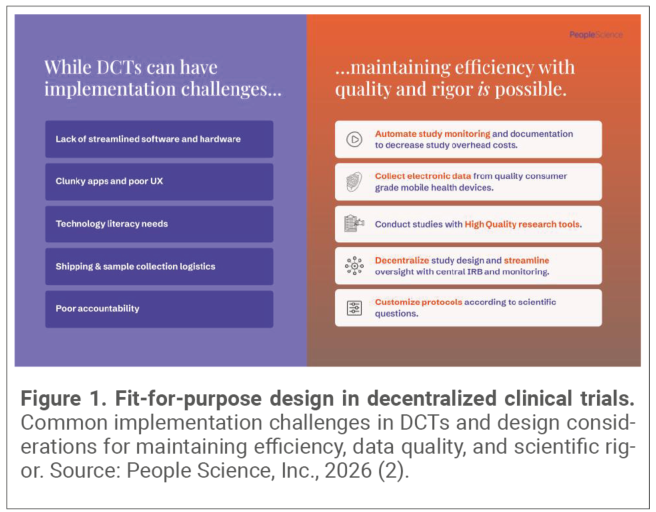
Dr. Alison Huang recently cautioned in JAMA that remote research is much more than substituting digital tools for in-person procedures (1). Many organizations have attempted fully decentralized studies by assembling off-the-shelf components: electronic consent, a survey platform, a wearable, a home-testing kit, a courier. While each component may perform well on its own, stitching them together creates friction points, and these friction points are where studies fail.
A participant misunderstands how to collect a specimen. A wearable stops transmitting without anyone noticing. A sample is collected correctly but stored or shipped incorrectly. Too many notifications cause participants to ignore study reminders.
When trial participation becomes confusing or burdensome, compliance drops and missing data increases. Rather than simply moving a procedure off-site, researchers must consider whether it can be performed remotely while preserving scientific integrity. The risk is transferring the burden from the research site to the participant (Figure 1).
Participant Experience Is Part of Data Quality
Participant experience is a top priority when conducting decentralized studies. This means the researchers or CRO need unique expertise. Teams require knowledge in protocol design and clinical operations, direct-to-participant logistics, home-testing capabilities, device connectivity, technology support, and data management. Planning the end-to-end participant journey is a critical component for successful implementation.
Operational implementation directly impacts quality. The ALCOA principles (data should be Attributable, Legible, Contemporaneous, Original, and Accurate) remain unchanged whether a measurement is collected at a research center or at home. What changes is how those requirements are achieved.
Consider a participant who is asked to record symptoms at 10 p.m. There is no coordinator standing beside them. Data quality may depend on whether the question is understandable, the interface intuitive, the reminder appropriately timed, and prompt support available when something goes wrong. Good decentralized design anticipates that moment through simple interfaces, clear instructions, integrated workflows, real-time compliance monitoring, and human follow-up when needed.
Fit-for-Purpose Also Means Fit for the Evidence Goal
Extending the principle of fit-for-purpose beyond study operations, a trial should be designed around what the resulting evidence needs to accomplish.
This is relevant to agrofood companies operating across jurisdictions. Evidence requirements for supplements and health claims differ between the United States, Canada, and the European Union. Research intended to contribute to an EFSA health-claim application may have different requirements from research intended to substantiate US structure/function claims or support consumer communications. Decentralization offers sponsors more cost-effective options for building evidence. A company might conduct a pivotal study where it best serves one regulatory objective while adding a geographically distributed US cohort to generate complementary data relevant to US consumers.
Because a single study rarely satisfies every regional requirement, designing research around the intended application allows companies to expand into new markets more strategically.
Different Questions Need Different Studies
Ingredient suppliers face a related challenge. Their clinical dossier may provide strong evidence for an ingredient, while brand customers need to understand how finished products perform with actual consumers.
A randomized controlled trial answers questions about efficacy under defined conditions. Consumer perception and real-world studies can answer different questions: How do people experience the finished product? Do they perceive meaningful benefits? Are they satisfied? Do those experiences change over time?
Decentralized research platforms enable these studies across geographically diverse populations. For instance, People Science LiveLabs allows brand partners to generate structured, real-world evidence on finished products directly with their consumers. These marketing studies complement the evidence of randomized controlled trials.
Sometimes the Real World Is the Right Laboratory
Not all studies are suited for a decentralized approach. When a trial requires invasive procedures, specialized equipment, close supervision, or tightly controlled environments, a physical research site remains the best choice. In cases where real-world data is also valuable, a hybrid model can offer an effective solution.
For many health questions, capturing measurements in daily life is both convenient and scientifically meaningful. Gut health is influenced by habitual diet, environment, travel, and routine. Women’s health involves biology and symptoms that change across menstrual cycles, preconception, pregnancy, and menopause. Sleep, stress, physical activity, digestive symptoms, and glucose patterns similarly fluctuate in ways an occasional clinic visit cannot capture.
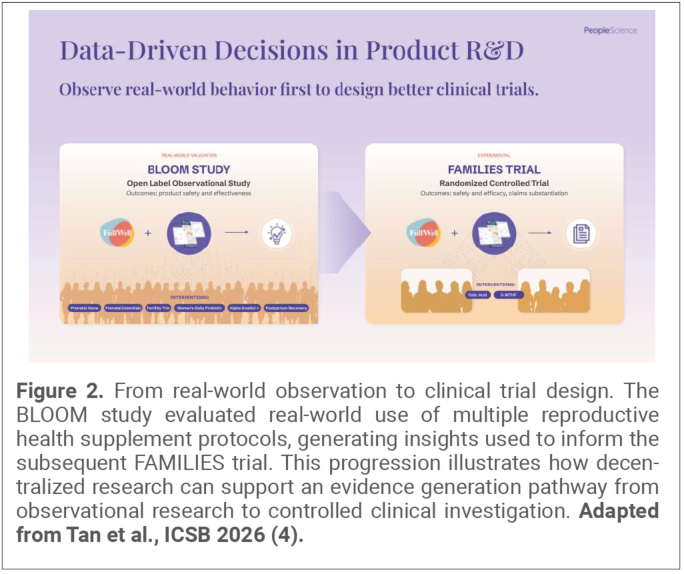
Supplement brand FullWell’s research program provides a solid example. Its BLOOM study used a longitudinal design to examine consumer participant experience with reproductive health products. The following FAMILIES study is a prospective, IRB-approved trial designed to compare methylfolate and folic acid, and evaluate blood folate biomarkers alongside reproductive outcomes in women trying to conceive (3). Following participants across the United States from preconception through long-term outcomes would pose significant challenges in a traditional site-based model. Decentralized infrastructure makes it possible to bring the research directly to participants (Figure 2).
And that brings us back to fit-for-purpose design. Decentralization should not be an end in itself, nor should technology; both are tools to serve a scientific purpose. The critical question is not “Can we decentralize this trial?” but rather “Which elements should be decentralized, for whom, and to fulfill what scientific objective?”.
References and notes
- Huang AJ, Marcus GM, Chan A. Virtual and Remotely Conducted Trials: Connection Without Contact. JAMA. 2026;335(18):1583–1585. doi:10.1001/jama.2026.2777
- People Science, Inc. Fit-for-purpose design in decentralized clinical trials. Internal company material, 2026.
- FullWell. FullWell launches first-of-its-kind study to answer a longstanding folate question and advance the future of women’s health research [Internet]. New York (NY): PR Newswire; 2026 Sep 15 [cited 2026 Sep 23]. Available from: https://www.prnewswire.com/news-releases/fullwell-launches-first-of-its-kind-study-to-answer-a-longstanding-folate-question-and-advance-the-future-of-womens-health-research-302878482.html.
- Tan B, Grant A, Barmmer A. Real World Fertility: From Participatory Research to Clinical Trial. 2026 International Conference on the Science of Botanicals (ICSB), Oxford, Mississippi; April 22, 2026. Oxford ICSB. 21.

From Soil Health to Business Resilience: Why Sustainability is no Long...

Complete Gut Health Solutions One Ecosystem. Seven Science-Led Strateg...

Peer-reviewed – Prebiotic Efficacy of a Fiber-Polyphenol Complex...

A Word With – Reyhan Nergiz Unal and Yingying Wu – PB Leiner

Peer-reviewed – Development of Plant-Based Sodium Alginate-Aloe...

A Word With – Shaheen Majeed – CEO & Managing Director, Sab...

Peer-reviewed – Probiotic yeasts for gut microbiota and immune d...

Peer-reviewed – Cellular Health Powering Fertility: Mitochondria...