
Introduction
Global demographic projections indicate a substantial and sustained shift toward an older population. Across the European Union, people aged 65 and over accounted for 22 per cent of the total population at the start of 2025, up from 19.1 per cent a decade earlier (1). Eurostat projects this group to grow from 90.5 million in 2019 to 129.8 million by 2050, with the share of those aged 85 and above expected to double over the same period (2). This shift places sustained pressure on healthcare and social security systems, and repositions healthy ageing as a strategic priority across the food, nutrition and pharmaceutical sectors.
Mobility in older age depends on the interplay of several physiological systems, including cardiovascular fitness, neuromuscular control and balance. Among these, the structural integrity of bone, skeletal muscle and articular cartilage represents a necessary foundation: without adequate bone strength, muscle mass and cartilage function, mobility cannot be maintained even when other systems are intact. Collagen is a principal structural protein of bone and cartilage, and a key component of the connective tissue that transmits muscular force: it forms the organic matrix that gives bone its flexibility, constitutes the majority of the dry mass of cartilage, and provides the structural framework of tendons, myotendinous junctions and intramuscular connective tissue through which muscle force is transmitted. As collagen turnover in these tissues slows with age, so does the structural capacity that keeps a person mobile, independent and able to withstand everyday physical loads.
Ageing of the musculoskeletal system follows distinct but interconnected trajectories in bone, cartilage and muscle. Bone mineral density declines progressively from midlife, more markedly in women following menopause; articular cartilage undergoes an age-related decline in chondrocyte proliferative and synthetic capacity, increasing susceptibility to degenerative joint changes (3); and skeletal muscle mass and strength decline progressively with age, a normal process that can, when it reaches clinically relevant thresholds, be classified as sarcopenia (4).
The clinical consequences are considerable: osteoporosis-related fragility fractures across the EU27 plus the United Kingdom and Switzerland incurred direct costs of approximately €57 billion in 2019, with the annual number of fractures projected to rise by nearly 25 per cent by 2034 (5). Across Europe, the prevalence of osteoarthritis reached an estimated 101 million cases in 2021, an increase of 48 per cent since 1990, with the highest burden observed in Western Europe (6). Sarcopenia prevalence estimates across European countries point to a similarly growing burden, with the number of affected older adults projected to rise from approximately 10.9 million in 2016 to 18.7 million by 2045, an increase of over 70 per cent (7).
For product developers working in healthy ageing, this has a practical implication: nutritional strategies need to target the specific tissue that is in decline, thus improving structural resilience: the capacity of bone, muscle and cartilage to withstand everyday and exercise-related loads. Specific bioactive collagen peptides have been investigated for their capacity to stimulate the cells responsible for maintaining each of these tissues – osteoblasts in bone and chondrocytes in cartilage, while the mechanism by which collagen peptides support muscle connective tissue remains to be fully understood. The purpose of this review is to summarise the clinical trial evidence for specific bioactive collagen peptides in relation to bone, muscle and cartilage health in the context of healthy ageing.
Osteoblast Stimulation and Bone Mineral Density
Bone comprises an inorganic mineral phase and an organic matrix in which type I collagen accounts for more than 90 percent of the organic matrix (8). The interaction between the mineral phase and the collagen network is what gives bone its combination of tensile strength and flexibility, properties that mineral content alone cannot supply (9). With age, and more markedly in women after menopause due to declining oestrogen levels, bone remodelling shifts toward net resorption: osteoclast activity increases relative to osteoblast-driven formation, and bone mineral density declines progressively throughout the skeleton. Clinical assessment conventionally focuses on the lumbar spine and femoral neck, the standard measurement sites for osteoporosis diagnosis defined by international guidelines (10).
Specific bioactive collagen peptides investigated for bone health are thought to function as signalling peptides that support osteoblast-driven matrix synthesis while moderating osteoclast-driven degradation – a dual mechanism distinct from that of calcium and vitamin D, which support mineralisation but do not directly address the collagenous scaffold itself.
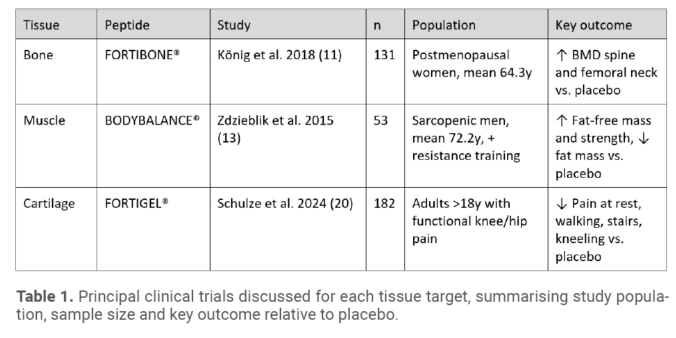
The principal clinical evidence for this mechanism comes from a randomised, double-blind, placebo-controlled trial in 131 postmenopausal women (mean age 64.3 years) with reduced BMD at the spine and femoral neck (11). Participants received either 5g/day of specific collagen peptides (FORTIBONE®; GELITA AG, Eberbach, Germany) or placebo for 12 months. BMD increased significantly at both measurement sites in the treatment group, while it continued to decline in the placebo group; bone formation markers rose accordingly, with no corresponding change in resorption markers. An independent systematic review and meta-analysis of 20 studies on collagen peptides and musculoskeletal health subsequently rated this trial as its highest-certainty evidence for bone outcomes (12).
Muscle: Sarcopenia and the Role of Collagen in Muscle Connective Tissue
Sarcopenia, defined by the European Working Group on Sarcopenia in Older People as a progressive and generalised skeletal muscle disorder characterised primarily by low muscle strength, contributes directly to falls and fracture risk, physical disability and loss of independence in older adults (4). It results from a combination of factors, including reduced anabolic sensitivity to protein intake, declining physical activity and hormonal changes. Unlike bone and cartilage, skeletal muscle is not itself a collagen-rich tissue in its contractile components; however, its intramuscular connective tissue and myotendinous junctions, which transmit the force generated by muscle fibres, are made mostly of collagen. This connective tissue framework requires continuous remodelling to preserve effective force transmission and support muscle protein accretion during resistance training.
Specific bioactive collagen peptides investigated for muscle health provide amino acid precursors, particularly glycine and proline, relevant to connective tissue turnover. The precise cellular mechanism by which these peptides may influence connective tissue remodelling, beyond their role as an amino acid source, remains an area of ongoing investigation.
The principal clinical evidence for older adults comes from a randomised, double-blind, placebo-controlled trial in 53 men with diagnosed sarcopenia (mean age 72.2 years) (13). Participants performed supervised resistance training three times weekly for 12 weeks and received either 15g/day of specific collagen peptides (BODYBALANCE®; GELITA AG, Eberbach, Germany) or placebo. Compared with placebo, the collagen peptide group showed significantly greater increases in fat-free mass and muscle strength, alongside a greater reduction in fat mass. The same independent meta-analysis discussed above identified this trial as showing the biggest effect on muscle strength among the muscle-focused studies it reviewed (12).
A larger trial of 97 untrained, middle-aged men (30–60 years) following an equivalent 12-week resistance training protocol reported comparable findings: collagen peptide supplementation again produced significantly greater gains in fat-free mass and fat loss than placebo, with a smaller exploratory whey-protein comparison group showing a less pronounced effect (14).
A comparable trial design in 77 premenopausal women following the same 12-week resistance training and 15g/day collagen peptide protocol reported similarly significant improvements in fat-free mass, fat loss and hand-grip strength relative to placebo (15). Together, these trials extend the observed benefit across a broader span of adulthood and in both sexes, from middle-aged, untrained men and premenopausal women to diagnosed sarcopenic older men.
All trials used supervised resistance training as a co-intervention, meaning the collagen peptide effect observed is in conjunction with, rather than a substitute for, structured exercise. This has a direct implication for product positioning: formulations should be communicated as a nutritional complement to resistance training programmes for ageing adults and not a standalone intervention.
Cartilage: Chondrocyte Stimulation and Joint Function
Across Europe, pooled prevalence estimates from a recent systematic review and meta-analysis indicate that approximately 6 per cent of adults have hip osteoarthritis and 10 per cent have knee osteoarthritis, based on data from more than 6.7 million individuals, with substantial regional variation (16). Age-specific data from a longitudinal study spanning six European countries show that among adults aged 65 to 85, clinical osteoarthritis at one or more joint sites – hand, knee or hip – affects approximately three in ten people, with prevalence rising sharply from midlife onward (17).
Articular cartilage is composed predominantly of type II collagen and proteoglycans, which together give the tissue its resistance to compressive and shear forces during joint movement (18). Unlike bone and muscle, cartilage is avascular and has a comparatively low intrinsic capacity for repair; its maintenance depends almost entirely on the metabolic activity of chondrocytes, the resident cells responsible for synthesising and maintaining the extracellular matrix. Articular chondrocytes exhibit an age-related decline in proliferative and synthetic capacity, while maintaining the ability to produce pro-inflammatory mediators and matrix-degrading enzymes — a shift that contributes to progressive matrix degradation (3). Osteoarthritis itself is multifactorial, but this age-related decline in cartilage maintenance is considered a key contributing process to the burden described above.
Specific bioactive collagen peptides investigated for joint health are thought to stimulate chondrocyte metabolism and extracellular matrix synthesis following systemic absorption. Because cartilage lacks a blood supply of its own, any nutritional strategy targeting this tissue depends on peptides or their metabolites reaching chondrocytes primarily via diffusion through the synovial fluid, rather than through direct vascular delivery – a distinct pharmacokinetic pathway compared with the vascularised tissues of bone and muscle.
Early clinical evidence for this mechanism came from a small imaging-based pilot trial in patients with mild knee osteoarthritis, which found a statistically significant increase in a cartilage-specific magnetic resonance marker (dGEMRIC) in the medial and lateral tibial regions of the knee following 48 weeks of supplementation, but no significant change in pain or function relative to placebo (19). More recent, larger trials have targeted functional pain outcomes directly. A randomised, placebo-controlled trial in 182 adults over 18 years of age with functional knee and hip pain during daily activities found that 12 weeks of supplementation with 5g/day of specific collagen peptides (FORTIGEL®; GELITA AG, Eberbach, Germany) significantly reduced physician-assessed pain at rest and during walking, alongside participant-reported reductions in pain when climbing stairs and kneeling, compared with placebo (20). A related trial using the same collagen peptides in 180 physically active adults aged 18 to 30 with exercise-related knee pain reported a similar reduction in pain relative to placebo (21).
Taken together, the evidence for cartilage-directed collagen peptides has moved from imaging-based surrogate outcomes toward directly assessed functional pain endpoints, which represents a methodological improvement over earlier trials in this area.
What Defines a Specific Bioactive Collagen Peptide?
Collagen is hydrolysed into shorter, water-soluble peptides to make it suitable as an oral ingredient. Specific bioactive collagen peptides differ from generic collagen hydrolysates in that their production is optimised and validated to yield a defined, reproducible peptide fingerprint – a specific distribution of peptide sizes and sequences. This defined composition is proposed to determine which peptide fragments interact with target cells in connective tissue, which is why findings for one such ingredient should not be assumed to apply to collagen hydrolysates generally.
Practical Considerations for Product Development
The three areas of evidence reviewed here point to a common practical conclusion: nutritional strategies based on collagen peptides for musculoskeletal ageing are tissue-specific rather than interchangeable. A formulation demonstrated to support bone mineral density in postmenopausal women does not, on that basis, offer evidence for muscle or cartilage benefit, and vice versa. For manufacturers developing healthy-ageing formulations, this argues for precise, evidence-matched positioning rather than generalised claims.
All three peptide preparations discussed share technical properties relevant to formulation – neutral taste, high solubility and stability under standard food and supplement processing conditions – which allow incorporation into powders, beverages, bars and functional foods.
Conclusion
Healthy ageing of the musculoskeletal system is closely linked to the structural integrity of bone, muscle and cartilage tissues. Specific bioactive collagen peptides have been investigated for their capacity to support each of these tissues, with the strongest available evidence coming from randomised controlled trials in postmenopausal women with reduced bone mineral density, older or middle-aged men undergoing resistance training, and adults with functional joint pain. An independent meta-analysis has corroborated the bone and muscle findings as high-certainty evidence within its scope, while more recent cartilage trials have moved from imaging-based surrogate markers toward direct pain outcomes.
At the same time, this evidence base points to clear directions for future research. Building on the populations studied to date – largely women for bone, men for muscle and adults with existing joint discomfort for cartilage – independent replication and studies extending to complementary populations would strengthen the evidence base further: men for bone health, older women for muscle health and long-term outcomes beyond 12 months, and structural disease-modification for cartilage. For manufacturers and product developers, the practical implication is that specific bioactive collagen peptides represent a scientifically grounded, but population- and outcome-specific component within a broader strategy for healthy musculoskeletal ageing.
References and notes
- Eurostat. Population structure and ageing. Statistics Explained. Luxembourg: European Commission; 2026. Available from: https://ec.europa.eu/eurostat/statistics-explained/index.php?title=Population_structure_and_ageing
- Eurostat. Ageing Europe – introduction. Statistics Explained. Luxembourg: European Commission; 2020 [cited 2026]. Available from: https://ec.europa.eu/eurostat/statistics-explained/SEPDF/cache/80392.pdf
- Loeser RF. Aging and osteoarthritis: the role of chondrocyte senescence and aging changes in the cartilage matrix. Osteoarthritis Cartilage. 2009;17(8):971–979. doi:10.1016/j.joca.2009.03.002
- Cruz-Jentoft AJ, Bahat G, Bauer J, Boirie Y, Bruyère O, Cederholm T, et al.; Writing Group for the European Working Group on Sarcopenia in Older People 2 (EWGSOP2). Sarcopenia: revised European consensus on definition and diagnosis. Age Ageing. 2019;48(1):16–31. doi:10.1093/ageing/afy169
- Kanis JA, Norton N, Harvey NC, Jacobson T, Johansson H, Lorentzon M, McCloskey EV, Willers C, Borgström F. SCOPE 2021: A New Scorecard for Osteoporosis in Europe. Arch Osteoporos. 2021;16(1):82. doi:10.1007/s11657-020-00871-9
- Igbokwe K, Ugwoke K, Obak OL, Igwe A, Ngwu JM. Comparing Osteoarthritis Burden Across Central, Eastern, and Western Europe (1990–2021): Insights From the Global Burden of Disease Study 2021. Cureus. 2025;17(9):e93585. doi:10.7759/cureus.93585
- Ethgen O, Beaudart C, Buckinx F, Bruyère O, Reginster JY. The Future Prevalence of Sarcopenia in Europe: A Claim for Public Health Action. Calcif Tissue Int. 2017;100(3):229–234. doi:10.1007/s00223-016-0220-9
- Tzaphlidou M. Bone architecture: collagen structure and calcium/phosphorus maps. J Biol Phys. 2008;34(1):39–49. doi:10.1007/s10867-008-9115-y
- Viguet-Carrin S, Garnero P, Delmas PD. The role of collagen in bone strength. Osteoporos Int. 2006;17(3):319–336. doi:10.1007/s00198-005-2035-9
- Slart RHJA, et al.; International Working Group on DXA Best Practices. Updated practice guideline for dual-energy X-ray absorptiometry (DXA). Eur J Nucl Med Mol Imaging. 2025;52(2):539–563. doi:10.1007/s00259-024-06912-6
- König D, Oesser S, Scharla S, Zdzieblik D, Gollhofer A. Specific collagen peptides improve bone mineral density and bone markers in postmenopausal women—a randomized controlled study. Nutrients. 2018;10(1):97. doi:10.3390/nu10010097
- Sun C, Yang A, Teng F, Xia Y. Efficacy of collagen peptide supplementation on bone and muscle health: a meta-analysis. Front Nutr. 2025;12:1646090. doi:10.3389/fnut.2025.1646090
- Zdzieblik D, Oesser S, Baumstark MW, Gollhofer A, König D. Collagen peptide supplementation in combination with resistance training improves body composition and increases muscle strength in elderly sarcopenic men: a randomised controlled trial. Br J Nutr. 2015;114(8):1237–1245. doi:10.1017/S0007114515002810
- Zdzieblik D, Jendricke P, Oesser S, Gollhofer A, König D. The Influence of Specific Bioactive Collagen Peptides on Body Composition and Muscle Strength in Middle-Aged, Untrained Men: A Randomized Controlled Trial. Int J Environ Res Public Health. 2021;18(9):4837. doi:10.3390/ijerph18094837
- Jendricke P, Centner C, Zdzieblik D, Gollhofer A, König D. Specific Collagen Peptides in Combination with Resistance Training Improve Body Composition and Regional Muscle Strength in Premenopausal Women: A Randomized Controlled Trial. Nutrients. 2019;11(4):892. doi:10.3390/nu11040892
- Christofides I, Vavliakis I, de Klerk HH, Verheyen C, Doornberg JN, et al. Prevalence of hip and knee osteoarthritis in Europe: a systematic review and meta-analysis. BMC Musculoskelet Disord. 2026. doi:10.1186/s12891-026-09493-7
- Castell MV, van der Pas S, Otero A, Siviero P, Dennison E, Denkinger M, et al. Osteoarthritis and frailty in elderly individuals across six European countries: results from the European Project on OSteoArthritis (EPOSA). BMC Musculoskelet Disord. 2015;16:359. doi:10.1186/s12891-015-0807-8
- Sophia Fox AJ, Bedi A, Rodeo SA. The basic science of articular cartilage: structure, composition, and function. Sports Health. 2009;1(6):461–468. doi:10.1177/1941738109350438
- McAlindon TE, Nuite M, Krishnan N, Ruthazer R, Price LL, Burstein D, et al. Change in knee osteoarthritis cartilage detected by delayed gadolinium enhanced magnetic resonance imaging following treatment with collagen hydrolysate: a pilot randomized controlled trial. Osteoarthritis Cartilage. 2011;19(4):399–405. doi:10.1016/j.joca.2011.01.001
- Schulze C, Schunck M, Zdzieblik D, Oesser S. Impact of Specific Bioactive Collagen Peptides on Joint Discomforts in the Lower Extremity during Daily Activities: A Randomized Controlled Trial. Int J Environ Res Public Health. 2024;21(6):687. doi:10.3390/ijerph21060687
- Zdzieblik D, Brame J, Oesser S, Gollhofer A, König D. The Influence of Specific Bioactive Collagen Peptides on Knee Joint Discomfort in Young Physically Active Adults: A Randomized Controlled Trial. Nutrients. 2021;13(2):523. doi:10.3390/nu13020523

From Soil Health to Business Resilience: Why Sustainability is no Long...

Complete Gut Health Solutions One Ecosystem. Seven Science-Led Strateg...
Peer-reviewed – Prebiotic Efficacy of a Fiber-Polyphenol Complex...

The Blueprint – How Functional Ingredients Pioneered the Digital...

A Word With – Reyhan Nergiz Unal and Yingying Wu – PB Leiner
Peer-reviewed – Development of Plant-Based Sodium Alginate-Aloe...

A Word With – Shaheen Majeed – CEO & Managing Director, Sab...

Peer-reviewed – Probiotic yeasts for gut microbiota and immune d...