


Laetitia d’Ursel, MBA
Head of Marketing, People Science, Inc., Brooklyn, NY, USA
Insights from our new column “The decentralized lens: navigating clinical trial challenges”
Abstract: The dietary supplement industry has begun designing studies around life stage, a welcome move away from broad claims for “adults” or “women”. In reality, life stages span years, and within them individuals experience shorter, pivotal moments, such as starting or discontinuing a supplement, or adjusting to a new product during its initial weeks, that fundamentally alter their needs. Using GLP-1 medicine users as a case study, this article argues that the next step is designing research for those moments. Decentralized studies make such precise recruitment practical, producing evidence buyers recognize as their own and moving results closer to the individual.
Life stage was the first step
Designing studies around life stages has become one of the most encouraging shifts in consumer health research. Instead of testing a product on “women” or “adults over 18”, ingredient suppliers and brands increasingly study reproductive age, perimenopause and menopause separately. Industry coverage now describes life-stage-specific clinical validation as increasingly essential for credible menopause claims (1). A 25-year-old and a 55-year-old no longer have to be averaged into the same result.
That is real progress. It is also only the first step. Life stages last years. Within those stages, individuals experience shorter phases that alter their needs, sometimes within weeks.
The moments within the journey
In my last column, I wrote about how scientific context gets lost as evidence travels from researcher to ingredient supplier, brand and consumer. This time I want to focus on the consumer end of that journey, and on how precisely research can meet them.
Three layers of timing shape what a consumer needs:
- Life stage, measured in years: Reproductive age, perimenopause and menopause; early and late older age. This is the layer the industry has started to design around.
- Journey stage, measured in weeks or months: Starting a medication, adjusting to it, maintaining results or stopping. Trying to conceive, each trimester, the first months postpartum. A training block, race week, recovery.
- Product-use stage, measured from the first dose: The first weeks with a new supplement, when people decide whether to continue, look very different from a year of daily use.
Marketers already speak to consumers at these moments. When research does the same, a study answers a sharper question: does this product help this person, at this point in their journey? That answer is also far easier for a buyer to recognize as their own.
A case study: the GLP-1 journey
GLP-1 medicines show how much a timing lens can reveal. In mid-2026, 11% of U.S. adults said they currently take a GLP-1 medicine for weight loss and 15% had tried one, up from 3% and 6% in 2024 (2). Oral options launched in 2026 are likely to bring in younger and less clinically severe users (3).
What stands out is not only the size of this population, but how much it moves. In a Danish registry of 77,310 people starting semaglutide, 52% stopped within a year (4). After stopping, about 60% of lost weight returns within a year (5).
So the group of people who have taken a GLP-1 is growing faster than the group who are taking one. This is not a single consumer segment. It is a journey, and each stage creates a different need and a different research opportunity (Figure 1).
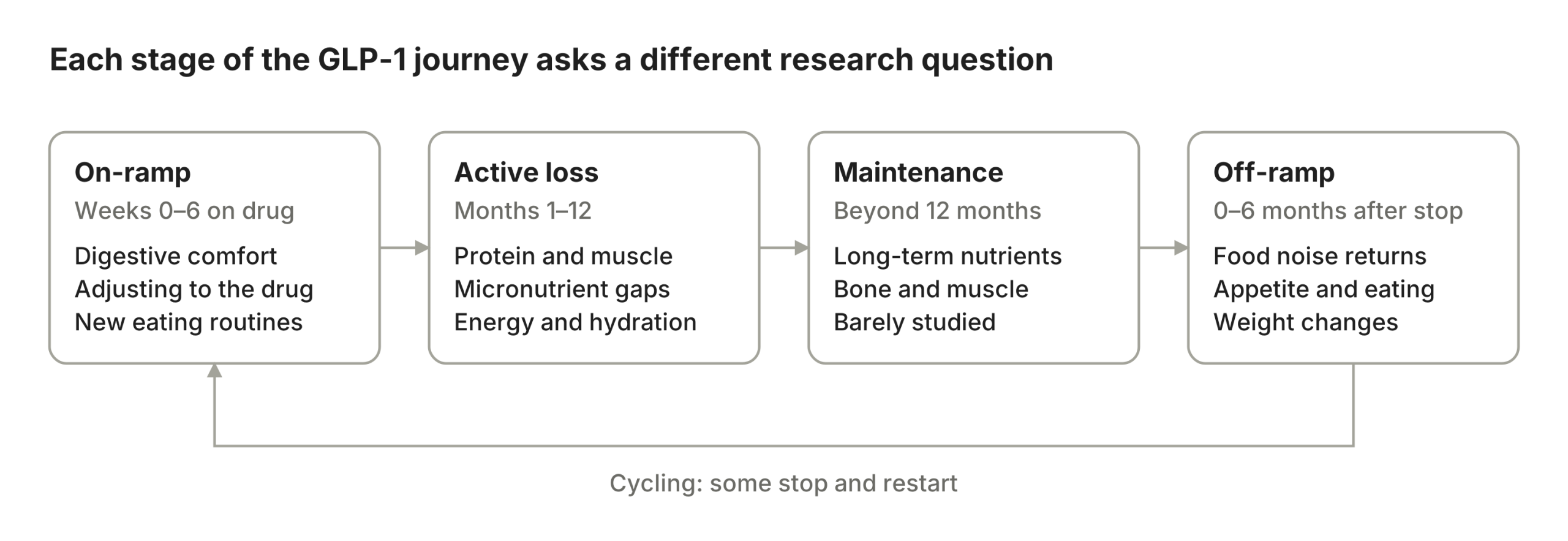
Figure 1. Needs shift at each stage, and some consumers stop and start. Source: People Science, Inc., 2026.
Each stage, its own study
Each stage invites its own research question. In the first weeks on the drug, a study might ask whether a food or supplement supports digestive comfort, measured with symptom scales and stool diaries over 4 to 12 weeks. After stopping, a study might follow how appetite and eating behavior change, measured with validated “food noise” and eating-behavior questionnaires over about six months (6). In between, protein and muscle maintenance, micronutrient status and even hydration each offer room for targeted products.
A product designed and studied for one stage can produce evidence that is directly relevant to the people in that stage. Designing for a stage means defining it precisely: time on therapy or time since stopping, drug and format, reason for use, documented weight-loss history and verified dosing. Those details turn a broad “GLP-1 user” into a well-described consumer at a known moment.
Some stages are still wide open. Long-term maintenance on the drug and cycling between courses are barely studied, which makes them opportunities for the first brands willing to build evidence there.
Moments within every life stage
GLP-1 is an unusually clear example, but the same layering applies across consumer health:
- Menopause: Within perimenopause, the first months of new symptoms differ from years of established ones, and needs shift again after the final period.
- Fertility and pregnancy: Trying to conceive, each trimester and the early postpartum weeks bring different priorities and outcomes.
- Sports nutrition: A training block, race week and recovery call for different support, even for the same athlete.
- Gut health: The weeks during and after a course of antibiotics are a distinct moment from everyday digestive support.
- New and long-term users: For almost any supplement, the first month and the first year are different experiences.
The consumer can even help define the moment worth studying. In BLOOM, a real-world fertility study sponsored by FullWell, 432 women chose among six supplement protocols and tracked their experience over five months. Their choices and outcomes are now shaping FAMILIES, a clinical trial designed to test the most promising protocol (7). In addition to receiving the evidence, consumers also participated in making decisions about the most meaningful research questions.
Reaching people at the right moment
Identifying the right moment is only useful if researchers can find the people experiencing it. While someone two weeks post-medicine or in their first trimester may be rare in a single town, they are reachable nationwide through decentralized research.
Brands can go a step further with their own customer data. A first order, a paused subscription or a switch from a prenatal to a postnatal formula each marks a moment in the journey. With consent, brands can invite people into a study at a defined time and under specific circumstances. Ingredient suppliers, who rarely hold this kind of customer data, can partner with brands to reach consumers at those moments, generating evidence for their ingredient in the finished products people actually use.
Designing for the moment
A few questions, asked before the protocol is written, help turn a journey into a study design:
- Which moment is this product for? Define it in weeks or stages, not only by a condition.
- How will we confirm people are at that moment? Medication start or stop dates, week of pregnancy, training calendar or first-use date.
- Do participants match the buyers at that moment? Compare them on sex, age, background and use, and report that match alongside the results.
- Which outcomes matter at that moment? Pair a physiological measure with one the consumer will recognize, such as quality of life or cravings.
- How long should the study last? Match the stage: weeks for early adjustment, months for maintenance or the period after stopping.
- Which market is the evidence for? Access and product formats differ across countries, so the population at each stage may differ too.
From the moment to the individual
Timing and personalization reinforce each other. Following each participant through a stage, with wearables, connected scales, at-home biomarkers and daily app check-ins, shows not only whether a product helps at that stage but how each person’s response unfolds over time.
Structured n-of-1 designs go further. They alternate product and control periods within the same person to estimate that person’s own response, and they suit outcomes that change quickly and reverse when the product stops. Population evidence answers “what happens on average?”. Moment-specific, individual evidence answers the question buyers actually ask: “what will this do for me, now?”.
Science for the moment
In my previous article, I argued that science should travel with the product. It can also meet consumers where they are. Designing around life stages taught the industry that “adults” and “women” are not study populations. The next lesson is that a life stage is not a single moment either.
The tools exist: national recruitment, home-based measurement and designs that follow each person over time. The opportunity is to use them with intention. For every product, two questions are worth asking: which consumer is the science for, and at which moment?
References
- Nutritional Outlook. Menopause nutraceutical market expands through clinical research and targeted innovation. https://www.nutritionaloutlook.com/view/menopause-nutraceutical-market-expands-through-clinical-research-and-targeted-innovation
- Gallup. In U.S., GLP-1 usage reaches new high (July 2026; updated September 2026). https://news.gallup.com/poll/712157/glp-usage-reaches-new-high.aspx
- FDA approvals of oral GLP-1 medicines: Wegovy pill (December 2025), https://www.pharmaceuticalcommerce.com/view/fda-approves-novo-nordisk-wegovy-pill ; orforglipron (April 2026), https://www.patientcareonline.com/view/fda-approves-orforglipron-first-oral-glp-1-receptor-agonist-for-weight-loss-with-no-food-or-water-restrictions
- Thomsen et al. Discontinuation of semaglutide for weight loss in the first 77,310 users in Denmark. EASD 2025, reported by https://www.medscape.com/viewarticle/real-world-study-finds-over-50-stop-glp-1s-within-1-year-2025a1000obm
- Budini B, Luo S, Tam M et al., Trajectory of weight regain after cessation of GLP-1 receptor agonists: a systematic review and nonlinear meta-regression, eClinicalMedicine, 2026; 93 https://www.thelancet.com/journals/eclinm/article/PIIS2589-5370(26)00043-X/fulltext
- Dhurandhar, E.J., Maki, K.C., Dhurandhar, N.V. et al. Food noise: definition, measurement, and future research directions. Nutr. Diabetes 15, 30 (2025). https://doi.org/10.1038/s41387-025-00382-x
- Tan B, Grant A, Barmmer A. Real World Fertility: From Participatory Research to Clinical Trial. Oral presentation, 2026 Oxford International Conference on the Science of Botanicals (ICSB), April 22, 2026. https://egrove.olemiss.edu/icsb/2026_ICSB/Schedule/21


