
Laetitia d’Ursel, MBA
Head of Marketing, People Science, Inc., Brooklyn, NY, USA
Insights from our new column “The decentralized lens: navigating clinical trial challenges”
Abstract: Clinical research generates rich scientific knowledge, but some of its context can be lost as evidence moves from researcher to ingredient supplier, brand, and ultimately consumer. Decentralized research, collaborative studies, wearables, n-of-1 approaches, and AI are creating new ways to bridge those gaps, shifting the nutraceutical industry from a chain of evidence handoffs toward a shared learning system.
Where Does the Science Go?
At Vitafoods Europe this May, I had a conversation with Agro FOOD Industry Hi-Tech editor Giulia Donatiello that stayed with me. We were discussing something we had both observed across the nutraceutical industry: at each step of the product journey, some of the science gets lost in translation.
It is not because the science disappears. The publication, clinical study report, or scientific dossier may still exist. What gets lost is often context: why a population or endpoint was selected, which participants responded, what the limitations were, and which findings were unexpected.
As results move from researchers to ingredient suppliers, the information is condensed. Suppliers translate the science for finished-product brands. Brands then face perhaps the hardest translation: communicating complex evidence to consumers through a package, product page, advertisement, or social post.
By the time the science reaches the person taking the product, a rich body of evidence may have become supports sleep, promotes gut health, or supports healthy glucose metabolism.
That led Giulia and me to a question: How can we make the science travel with the product?
The Problem Is Not Evidence, It’s Translation.
Imagine a clinically studied ingredient moving through the commercial ecosystem: from researcher to ingredient supplier, to brand, to consumer.
Each needs something different. Researchers focus on protocols, endpoints, variability, adherence, and limitations. Suppliers need to understand what the evidence demonstrates about their ingredient. Brands need to connect it to their formulation, dose, consumers, and positioning. Consumers want to know: What does this science mean for me?
These questions originate from the same evidence. The opportunity is to build better bridges between them.
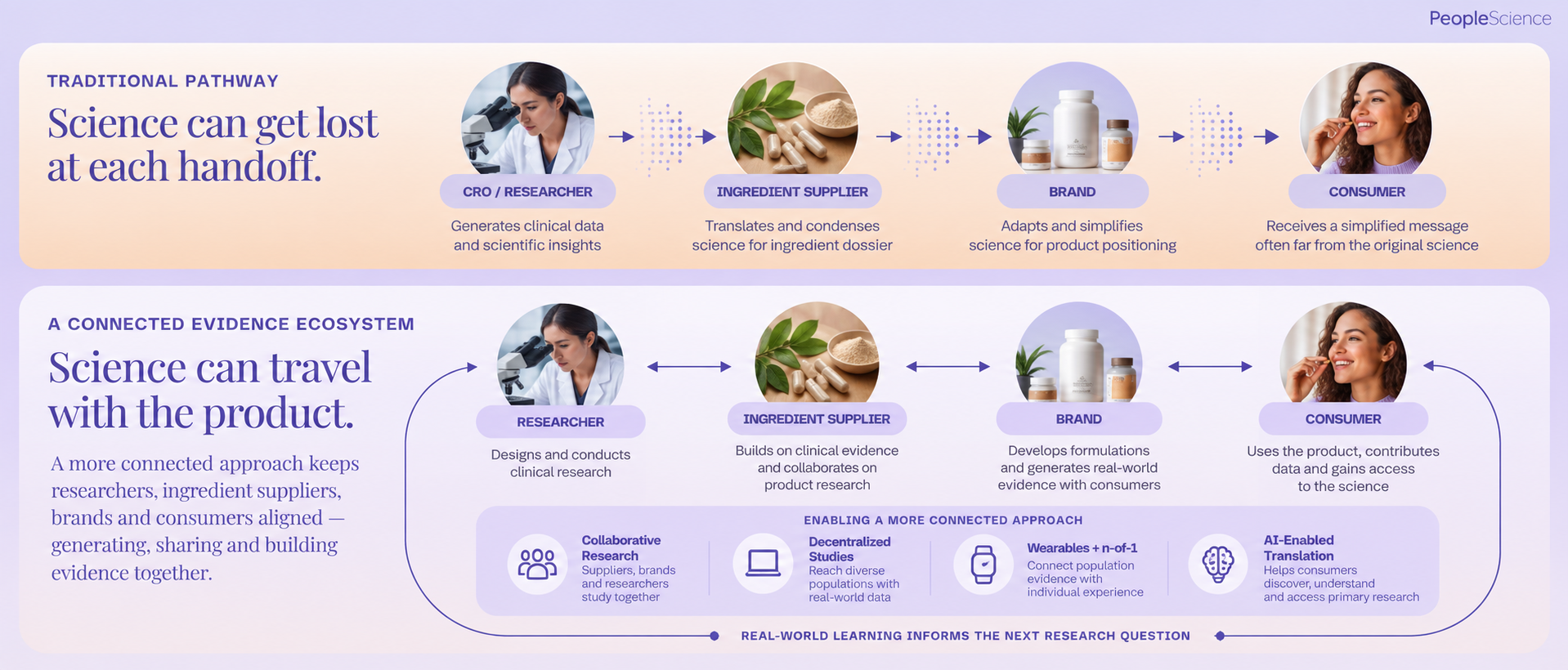
Figure 1. From evidence handoffs to a connected learning system. Source: People Science, Inc., 2026.
Closing the First Gap: Researcher to Ingredient Supplier
A clinical trial generates far more knowledge than the findings that ultimately appear in a publication. Researchers learn about recruitment, adherence, endpoint sensitivity, participant behavior, unexpected signals, and operational realities.
Those insights can shape what comes next. Which endpoints should be investigated again? Were there responder patterns worth exploring? Was the dose appropriate? What would researchers design differently next time?
Clinical research can therefore be both a test of a hypothesis and a source of knowledge for the next stage of product development. Maintaining continuity between researchers and ingredient developers helps preserve that knowledge and create evidence strategy rather than one-offs.
Closing the Second Gap: Ingredient Supplier to Brand
Ingredient suppliers may invest significantly in clinical research, yet the brand often becomes a recipient of the science rather than a participant in creating it.
That is beginning to change. Suppliers and brands can collaborate directly on human research, asking questions together, selecting endpoints, studying ingredients within finished formulations, and sharing what they learn. Decentralized research makes this easier. Shared platforms like People Science’s Chloe, can support geographically distributed recruitment, direct-to-participant product shipment, remote questionnaires, wearables, at-home measurements, and shared visibility into study progress and data.
The important shift is larger than the technology. Instead of the supplier saying, “Here is our science; now translate it for your product”, the relationship becomes: “Let’s generate the next layer of science together”.
Closing the Third Gap: Brand to Consumer
The final transition may create the greatest distance between research and the person it is intended to benefit. But consumers no longer need to be only recipients of translated evidence. They can increasingly participate in generating it.
One emerging model brings ingredient suppliers, finished-product brands, and consumers into the same research ecosystem. We are exploring this approach at People Science through Chloe LiveLab, where suppliers and brands collaborate on real-world research with the people actually using their products. The model connects an ingredient’s existing scientific foundation with evidence from its use in a finished product. The supplier brings the foundational science; the brand brings the formulation and its consumer community; and participating consumers contribute structured data about their real-world experience and outcomes.
Everyone learns together. Suppliers see how their ingredients translate into finished formulations. Brands generate evidence specific to products their customers actually use. Consumers participate directly in the science. The science is no longer simply moving toward the consumer. It is being generated with the consumer.
From Population Science to the Science of the Individual
Real-world research can go further when combined with wearables, continuous glucose monitors, connected scales, at-home biomarkers, and other technologies that capture outcomes longitudinally. This connects population-level evidence with individual experience.
Traditional clinical research asks what happens across a study population. But averages can obscure substantial individual variability: two people taking the same nutritional product may respond differently. Repeated measurements can characterize individual trajectories, while more structured n-of-1 designs can personalize outcomes by alternating multiple intervention and control periods to investigate individual response.
The two perspectives answer different questions: Population research asks “What happens on average?”, individual research asks “What happened to me?”. Connecting them could make scientific evidence considerably more meaningful to consumers while generating new questions for product research.
AI Can Help Consumers Travel Back to the Science
Artificial intelligence may also change how science reaches consumers. Rather than depending only on evidence translated through packaging and advertising, consumers can use AI-assisted research tools to locate publications, compare studies, and translate technical concepts into accessible language. Consumers can begin to travel backward through the evidence chain toward the original science.
But scientific translation is more than summarization. Trustworthy AI needs to distinguish an RCT from an observational study, consider whether the studied dose and population are relevant, surface conflicting evidence and limitations, and maintain traceability to original sources. The opportunity is not simply AI that tells consumers whether something “works”. It is AI-enabled scientific translation with provenance.
Making Science Travel: From Handoffs to Shared Learning
The nutraceutical industry does not necessarily have a shortage of science. It has a challenge of scientific continuity. Context can be lost when a clinical study becomes an ingredient dossier, an ingredient dossier becomes a brand brief, and a brand brief becomes a consumer claim.
The solution is not to eliminate translation, but to connect the people involved in it. Decentralized research can help suppliers and brands collaborate. Real-world studies can bring consumers into evidence generation. Wearables and n-of-1 approaches can connect population findings with individual experience. AI can make primary research more accessible and navigable.
Perhaps that is how we prevent science from getting lost along the product journey: not simply by becoming better at passing evidence downstream, but by creating a shared learning system where researchers, ingredient suppliers, brands, and consumers can generate, translate, and learn from science together.