
Introduction
Health and wellness is no longer a discrete product category or an occasional consumer consideration. It has become a structural influence on food and nutrition, shaping ingredient selection, product development, brand positioning, and portfolio strategy.
The shift is broader than any single trend. Consumers are seeking support across physical, metabolic, digestive, cognitive, and emotional wellbeing. Healthy ageing and longevity form part of this picture, but the underlying ambition is more immediate: consumers increasingly want to preserve appearance, function, energy, and resilience throughout life rather than waiting to address health concerns later. Our analysis describes this as a move from reactive health management towards more proactive and preventative nutrition (1). As a result, as Figure 1 illustrates, health and wellness now interact with a wider set of consumer priorities rather than operating as a standalone trend.
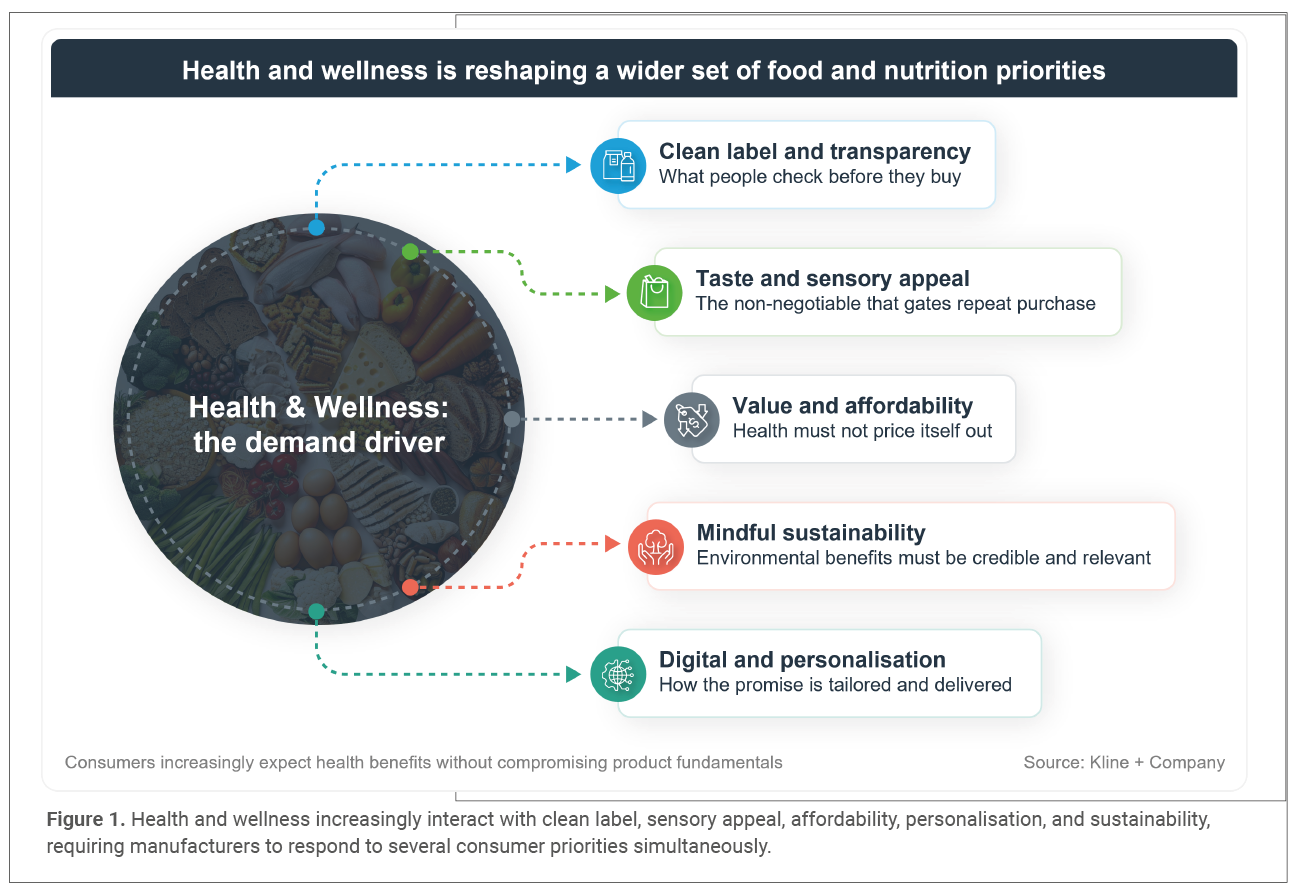
For the food and nutrition industry, the consequence is significant. Products are increasingly expected to do more than provide basic nutrition or indulgence. They must fit into everyday routines, deliver an intelligible benefit, and provide consumers with a credible reason to believe.
Health benefits are moving into everyday formats
Functional food and beverages are well placed to respond because they allow health benefits to be integrated into familiar consumption occasions. A functional beverage, snack, yoghurt, or cereal can become part of a morning or daytime routine or other consumption occasion without requiring the consumer to adopt a separate health regimen.
This is already visible in the way mainstream products are being reformulated around specific wellness occasions. High-protein yoghurts and drinks have moved protein from the sports aisle into breakfast and snacking, while kombucha, kefir-style drinks and fibre-enriched beverages have helped make digestive health part of ordinary daily consumption rather than a specialist supplement occasion.
This represents a significant difference from conventional food and beverage products. Conventional products continue to compete on taste, convenience, price, and familiarity. Crucially, functional products must retain these attributes while also delivering an additional nutritional or health proposition. Functionality cannot compensate indefinitely for an unsatisfactory sensory experience, an inconvenient format, or an unclear benefit.
Health functionality is also becoming more multidimensional. Products are moving beyond single, narrowly framed claims towards combinations such as protein and fibre, protein and biotics, or sweetening and functional-fibre systems. Our internal analysis highlights growing convergence among fibres, biotics, proteins, and sweeteners as manufacturers seek to support several consumer needs within one product (2).
The $11.6 billion global biotics ingredients market illustrates how this transition is occurring (3). Probiotics have an established presence in yoghurt, fermented products, and supplements, while prebiotic fibre and gut-health positioning are moving into beverages, snacks, and other everyday formats. Consumer familiarity differs by ingredient type, and emerging areas such as postbiotics are less widely understood. Nevertheless, the direction of development is towards a broader range of applications and benefits, including digestive health, metabolic health, mental wellbeing, women’s health, oral health, and healthy ageing.
In practice, this often means designing around a usage occasion rather than a single ingredient story: a drinkable yoghurt may combine protein for satiety, live cultures or prebiotic fibre for digestive positioning and reduced sugar to support a more balanced nutrition profile. The consumer sees one convenient product, but the development challenge sits in making multiple systems work together.
This breadth creates commercial potential, but it also means that the functional proposition must be more disciplined. A product cannot credibly promise every possible benefit. Successful innovation starts by defining the consumer, the need, and the intended outcome before selecting the ingredient and format.
Reformulation is becoming a systems challenge
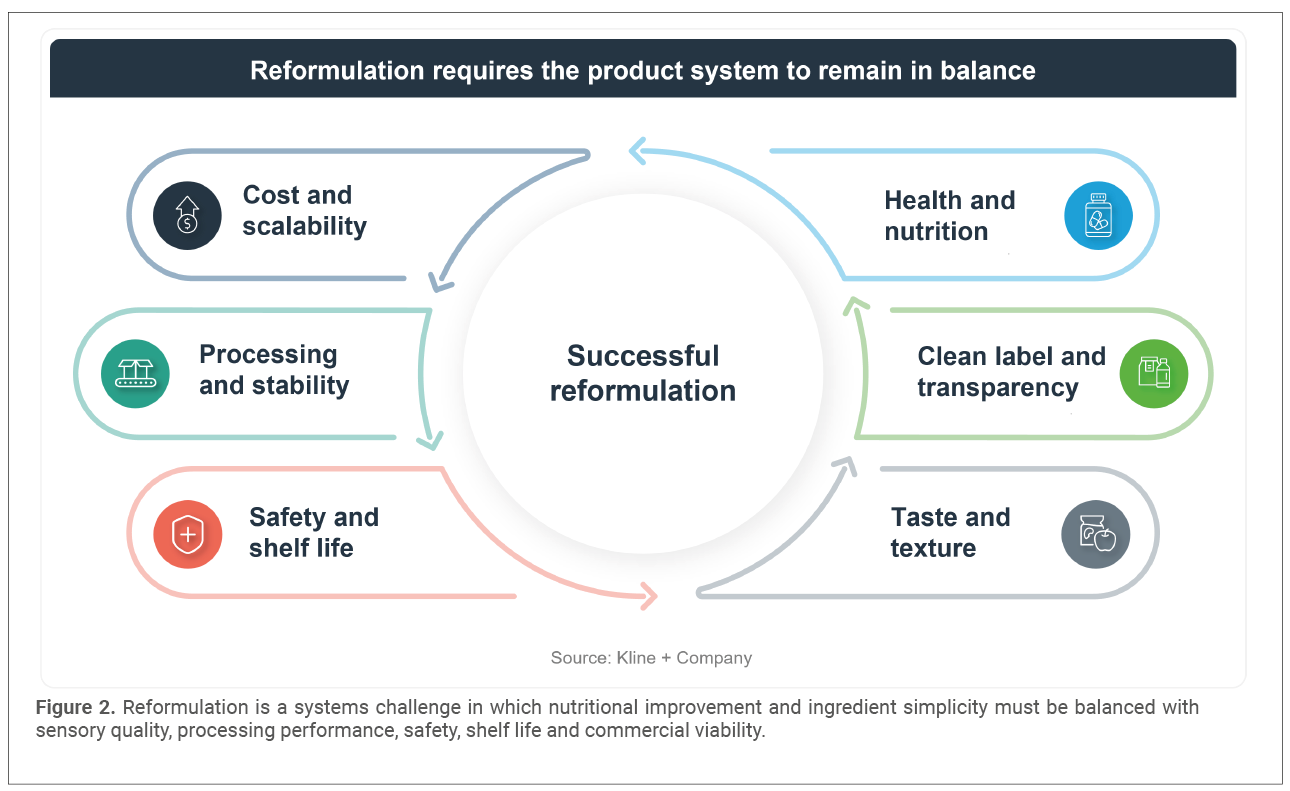
The growth of functional nutrition is taking place alongside rising expectations for simpler, more transparent products. Clean label is moving from a differentiator towards a widespread development requirement. At the same time, manufacturers face pressure to reduce sugar, remove ingredients perceived as artificial, address concerns about processing, and maintain taste, affordability, safety, and shelf life.
These requirements are frequently in tension. Sugar does more than provide sweetness. It may contribute bulk, texture, colour, preservation, and overall sensory quality. Preservatives support safety and shelf life but can appear inconsistent with a simplified, “clean label” back of pack ingredient list. Proteins, fibres, probiotics, and botanical ingredients can affect acidity, texture, flavour, solubility, and stability.
Consequently, reformulation is rarely a direct exchange of one ingredient for another. Removing or replacing one component may affect several parts of the product system. The interdependence of these requirements makes reformulation a systems challenge rather than a simple ingredient substitution, as shown in Figure 2.
Alternative sweeteners present a similar challenge. Manufacturers now have a wider set of options, including high-intensity sweeteners, polyols, and rare sugars, but the suitability of each solution depends on the application, processing conditions, regulatory environment and required sensory profile. The objective is not simply to remove sugar, but to rebuild the functions that sugar previously provided. Our work therefore points to increasing interest in sweetening systems and blended solutions rather than reliance on a single replacement ingredient (5).
This changes the role of ingredient suppliers. Suppliers increasingly need to provide application knowledge, formulation support, and performance validation alongside the ingredient itself. The competitive advantage may sit less in owning a single “hero” ingredient and more in helping customers navigate the interactions between nutrition, sensory quality, processing, stability, and claims.
Evidence must survive the journey into the finished product
Functional ingredients can have a compelling scientific rationale, but commercial success depends on whether that rationale remains valid in the finished format.
This is particularly clear in biotics. Benefits may be specific to a strain or preparation, dose, population, and endpoint. Evidence associated with one strain cannot automatically be transferred to another. In live probiotics, the specified viable count must also be delivered after manufacturing and throughout the product’s shelf life. Heat, moisture, oxygen, acidity, and interactions with other ingredients may all affect performance.
The challenge is therefore not only to identify an ingredient with evidence. It is to connect the target consumer, intended benefit, effective dose, processing conditions, final application, and proposed claim. The closer the commercial product remains to the conditions under which the evidence was generated, the stronger its credibility is likely to be.
This principle applies beyond biotics. As functional food and beverages carry more sophisticated benefits, product developers must avoid allowing the marketing story to move ahead of the science or the formulation. Claims must reflect the strength and specificity of the evidence, while remaining simple enough for consumers to understand.
Established category boundaries are becoming less distinct
Historically, conventional food and beverages, dietary supplements and medical nutrition occupied relatively distinct positions. Supplements offered concentrated doses in formats such as capsules, tablets, and powders. Medical nutrition was strongly associated with defined nutritional needs and more clinical usage. Functional food and beverages sat closer to ordinary food consumption.
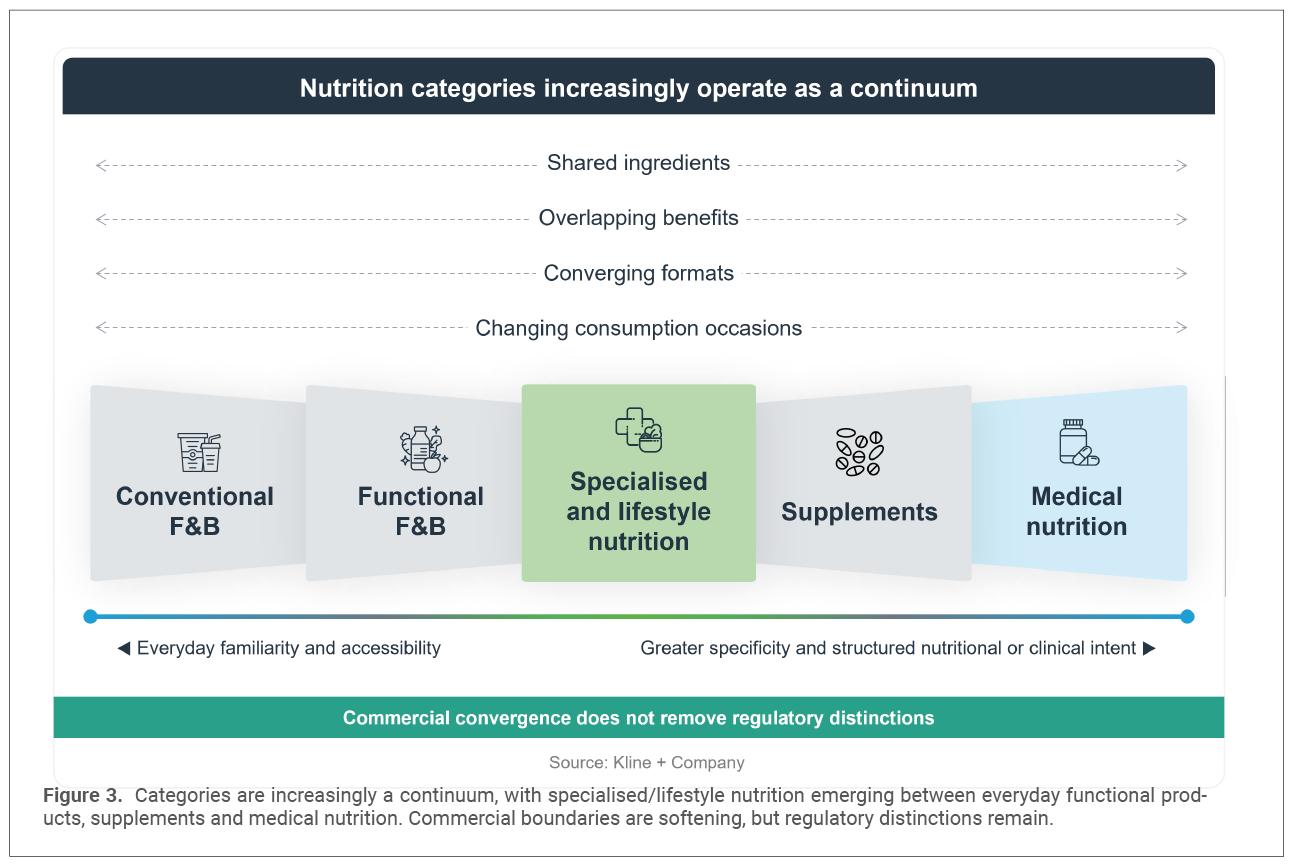
The market is now evolving along more of a continuum. Supplements are adopting food-like formats such as gummies, bars, shots, and beverages. Functional products are using ingredients and evidence strategies historically associated with supplements and even pharmaceuticals. Meanwhile, a middle space is emerging between medical nutrition and mainstream consumer wellness. This area can be described as specialised and lifestyle nutrition: products with clearer functional intent and stronger credibility cues than conventional wellness products, but with greater accessibility and everyday relevance than medical nutrition (6).
The convergence is happening at several levels:
- Ingredients: proteins, fibres, biotics, lipids, and other health ingredients can be used across food, beverages, supplements, and specialised nutrition.
- Benefits: digestive, metabolic, immune, cognitive, and musculoskeletal benefits increasingly appear across multiple product categories.
- Formats: powders, bars, gummies, shots, and ready-to-drink products no longer belong exclusively to one category.
- Consumer occasions: products may support a daily routine, a life-stage need, physical performance or condition-adjacent nutritional support.
Its showing up as collagen drinks, protein bars, hydration powders and gummy supplements, which borrow cues from both food and supplement categories. These products are marketed around everyday routines and lifestyle outcomes, but they also rely on ingredient dosages, substantiation and claims language that are closer to the supplement world than to conventional food.
However, commercial convergence does not remove legal or regulatory distinctions. Product classifications permitted terminology and health-claim requirements continue to vary by region and category. The apparent similarity of two formats does not mean they can make the same claims. Figure 3 illustrates how these categories increasingly operate as a continuum, while retaining important regulatory distinctions.
The opportunity lies in integration
The next phase of functional nutrition will be shaped less by how many ingredients can be added to food and beverages, and more by how effectively science, formulation and everyday consumption come together.
Manufacturers need to begin with a clearly defined consumer and a meaningful need. Ingredient choice must then be linked to a supported dose, an achievable formulation, and a format that consumers will use consistently. Reformulation should be managed as a system, recognising that changes to sugar, preservatives or functional ingredients can affect the entire product. Claims must be specific enough to be credible and straightforward enough to be understood.
For ingredient companies, this creates an opportunity to move from component supplier to formulation and innovation partner. Customers will increasingly value suppliers that can combine scientific understanding with application expertise, regulatory awareness, and sensory performance.
Health and wellness will continue to influence growth across food, beverages, and nutrition. Longevity will remain one manifestation of that wider shift, but the immediate opportunity is more practical: helping consumers address identifiable health priorities through products that fit naturally into everyday life.
As category boundaries continue to soften, the winners will be those that make functionality credible, formulation robust and consumption simple.
References and notes
- Kline + Company. Nutrition + Longevity: From Lifespan to Healthspan, Mapping Ingredients, Benefits and Formats in Longevity Nutrition. Vitafoods Conference Presentation; 2026. https://klinegroup.com/food-nutrition/longevity-nutrition-healthspan-trends/
- Kline + Company. Transforming Nutrition: The Future of Functional Food & Beverages. Kline NutraTech Conference Presentation; 2026. https://klinegroup.com/food-nutrition/top-food-nutrition-trends-2026-kline/
- Kline + Company. Biotics Intelligence Center. Kline syndicated market insight, 2026. https://producthub.klinegroup.com/food-&-nutrition/global-biotic-ingredients-market-outlook
- Kline + Company. Global Food & Beverage Preservatives Market: Key Trends, Application Hotspots and Strategic Outlook. Kline Webinar; 2026. https://klinegroup.com/food-nutrition/food-preservation-strategies-application-specific/
- Kline + Company. The Next Wave of Sugar Reduction. Kline Article, 2026. https://klinegroup.com/food-nutrition/sugar-reduction-innovation-sweeteners-industry/
- Kline + Company. Food and Nutrition Convergence: The Blurring of Food, Nutrition and Medical Nutrition. Kline article; 2026. https://klinegroup.com/food-nutrition/food-and-nutrition-convergence/
- Kline + Company. Functional Nutrition and Health Ingredient Innovation. Internal presentation; 2026.

From Fibremaxxing to Fibremixxing: Why Fibre Diversity Matters

From Soil Health to Business Resilience: Why Sustainability is no Long...

Complete Gut Health Solutions One Ecosystem. Seven Science-Led Strateg...

Peer-reviewed – Prebiotic Efficacy of a Fiber-Polyphenol Complex...

The Blueprint – How Functional Ingredients Pioneered the Digital...

A Word With – Reyhan Nergiz Unal and Yingying Wu – PB Leiner

Peer-reviewed – Development of Plant-Based Sodium Alginate-Aloe...

A Word With – Shaheen Majeed – CEO & Managing Director, Sab...