Introduction
Gastrointestinal (GI) discomfort affects a large proportion of the population and can impair quality of life. GI discomfort symptoms are often recurrent and are characterized by heartburn/epigastric pain, postprandial fullness, bloating and burping (1). Generally, these symptoms are also accompanied by nausea and abdominal cramps/spasms. This cluster of symptoms without an underlying pathophysiology is known as functional GI disorders. GI symptoms are predominantly meal-related symptoms as they get aggravated after meal consumption (2). The prevalence of bloating based on population studies is estimated between 16-30% (3).
Physiological factors such as excess acid secretion, delayed gastric emptying, visceral hypersensitivity, disordered communication between gut-brain, as well as psychological factors such as stress and depression are involved in the development of GI disorders. GI discomforts are widely reported in patients with undiagnosed Helicobacter pylori gastritis or in subjects with irritable bowel syndrome (4). Due to the multifactorial nature of this condition, monotherapy might not be appropriate for all patients. Thus, symptom relief is regarded as the primary treatment option in these cases. Proton pump inhibitors (PPI) are widely used as first line therapy for GI discomfort. However long-term use of PPI poses health risks (5). Traditional and natural ingredients offer an interesting option for the management of GI discomforts in primary intervention. Products derived from plant sources such as Iberogast, motilitone has been widely used for the treatment of GI discomforts (6). Perilla frutescens is one such plant which has been used in Asian countries for various applications such as antiallergic, antimicrobial and anti-inflammatory activity (7). Perilla frutescens leaves have also been explored for their beneficial effect on gastrointestinal health (8).
In this context, a previously characterized (8) proprietary standardized extract of Perilla frutescens (L.) Britton, with a phytochemical composition of phenolic acids, mainly rosmarinic acid and a flavonoid fraction was investigated. This standardized extract has previously displayed chronic beneficial effects on GI discomfort relief in a pilot clinical trial and has also displayed antispasmodic effects in an in vitro mechanistic study. This study aims to determine whether the standardized extract of Perilla frutescens can alleviate overall GI discomfort in a post-meal acute setting. Secondary outcomes include evaluating changes in individual GI discomfort symptoms postprandially after a high-calorie meal.
Methods and materials
Study population
Healthy volunteers (male and female) in the age of ≥ 25 and ≤ 70 years and BMI of 19-30 kg/m2 without clinically diagnosed diseases with relevant effect on gastrointestinal system were included in the study. After informed consent, subjects were screened for their eligibility to take part in the study. Exclusion criteria included subjects who were diagnosed with any medical condition or under prescription medications for digestive symptoms. Further exclusion criteria are mentioned in the supplementary information. Lifestyle, nutritional and sporting habits were assessed during screening. Subjects were instructed to keep their normal nutritional, sporting and lifestyle habits. The clinical study was performed at the study site of BioTeSys GmbH in Esslingen, Germany. The protocol was approved by the Institutional Review Board (IRB) of Landesärztekammer Baden-Württemberg (Ethical committee number: F-2022-093). Study was conducted in accordance with Good Clinical Practice and was registered in clinicaltrials.gov (NCT05603416).
Study product and study design
Study product was composed of Filler sorbitol (ad 100%), Benegut® (15.0%, 300 mg per portion), aroma (1.5%), release agent magnesium salts of fatty acids (0.16%), sweetener steviol glycosides (0.15%). Benegut®, a proprietary extract of Perilla frutescens (supplied by Biotexia, France), is standardized on a special flavonoid fraction, on vicenin 2 and on rosmarinic acid, determined by HPLC (8). Placebo contained maltodextrin with the same excipients as the study product. Both the products were provided as direct dissolve preparation in sticks and ingested orally directly after end of a high-calorie meal as single dose.
The study was performed as a double-blind, randomized, placebo-controlled cross-over design with at least a 7-day washout phase between visits. After the screening/baseline visit, the consumption of the test meal was repeated twice in combination of intake of Benegut® supplementation or placebo. During the screening phase a high-calorie meal was served, to determine their individual portion causing GI discomfort. Briefly, they consumed cheeseburger, coleslaw, tortilla chips/nachos/tacos with cheese dip and salsa dip, ketchup/mayonnaise, chocolate muffin and lemonade, until the defined GI discomfort level was reached. As previous meal could have a carryover impact on GI complaints, an easy to digest light meal was first provided in the lunch. The time of this last meal prior to the high-calorie meal was also standardized with 5 hours. Subjects were instructed to eat as much as they could and then rate their overall GI discomfort. Only subjects with minimum overall GI discomfort of 5 on a visual analog scale (VAS, 0-100mm) were enrolled. Only subjects experiencing such a cut-off value after the meal have been included. The amount of food consumed during the “overeating dinner” at screening visit was standardized for visit 1 and visit 2. The screening visit was considered as the baseline level of each participant as this involved symptom registration without placebo or the product.
The study products were ingested directly after the meal. The assessment of GI symptoms was done over a period of 90 min after intake of study products, during which subjects stayed under calm relaxing conditions. During this time, subjects were rating their overall GI-discomfort on a VAS at defined time points (0, 5, 15, 30, 45, 60 and 90 min). Additionally, the nature and severity of selected symptoms (feeling of fullness, burping, bloating, heartburn, rumbling, passage of gas, GI discomfort/cramps/pains, nausea, urge to defecate) were assessed at the specified time points with a 6-point Likert scale. Participants also answered the questionnaire 10-15 minutes before the beginning of meal ingestion (-15 min). Questionnaires evaluating bowel movements were also registered at each visit. Safety at each visit was ensured by recording any adverse events in accordance with ICH/GCP.
Sample size
Based on the previous clinical study (8) a subjective alleviation of symptoms was reported in women for bloating and abdominal discomfort with -0.57 ± 0.63 and during placebo intervention of -0.19 ± 0.53. Based on these data applying a matched pairs test approach and consideration of an alpha level of 0.05 and power of 0.8, an effect size of 0.65 was estimated for the a priori sample size determination using G*power 3.1.9.2. Based on the following input details – two tailed, effect size d=0.65, alpha error problem: α=0.05, actual power: 80%, correlation between groups: 0.5 – a sample size of n=21 subjects was estimated. As women are predominantly affected by gastrointestinal complaints (9) and to ensure an adequate sex distribution while exceeding the minimum required sample size, 30 subjects were enrolled with an approximately 3:1 ratio of women to men, respectively (n=22 women and n=8 men).
Statistical analysis
All the values are reported as mean and standard deviation. For the incremental AUC, baseline corrected (score prior to meal start) symptom scores were used. Differences amongst groups were evaluated with linear mixed model that accounts for repeated measures. Statistics were performed in R software (4.1.2).
Results
Population characteristics
Thirty participants (22 women and 8 men) with a mean of 47.6 (SD 11.1) years and BMI of 25.2 (SD 3.3) Kg/m2 participated and completed the study. Average calories consumed from the high calorific meal was 1551 Kcal (95% CI 1346-1756). Portion size was individually defined by subjects during the baseline visit.
There were no significant differences in bowel movements during the three visits (data not shown).
Tolerability and safety
Tolerability and safety were assessed by asking and recording all reported adverse events. Two adverse events were noted on the study days, which were already present when the subjects arrived to the study site. None of the adverse events were related to the study products.
Overall GI discomfort
Participants reported similarly low levels of GI discomfort before the start (pre-test) of the high-calorie meal at all the three visits. Overall GI was assessed on a VAS and the incremental area under the curve (iAUC) was calculated for overall GI discomfort from 0 to 90 min post intake of the study products. The primary endpoint iAUC0-90 min for overall GI-discomfort (Table 1) was significantly lower after intake of standardized Perilla frutescens leaf extract (3073±1255) in comparison to intake of placebo (3742±1611) (p=0.0061) with 66.7% of subjects having lower iAUC0-90 min overall GI discomfort after intake of supplement in comparison to placebo. The maximum symptom score observed (denoted by Cmax) also reduced in supplement and placebo in comparison to baseline visit. When leaving the study site after 90 min, the overall GI discomfort was not returned to the baseline conditions.
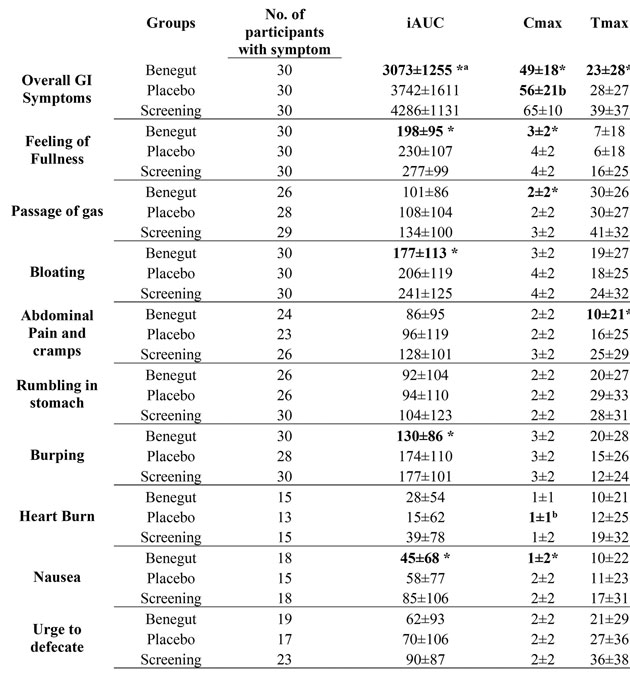
Table 1. Incremental AUC (0-90min) of overall GI discomfort and individual symptoms with maximum symptom score (Cmax) and time at which maximum symptom score occured (Tmax).
* = significant difference between Benegut® and screening visit; a = significant difference between Benegut® and Placebo; b = significant differences between Placebo and Screening.
Individual GI discomfort symptoms
Nine individual GI symptoms were measured during three visits. Similar to overall GI discomfort, iAUC0-90 min was calculated for each symptom. Feeling of fullness, bloating and burping were the three main prevalent symptoms. Heart burn, nausea and urge to defecate were the less prevalent symptoms. The iAUC0-90 min of feeling of fullness, bloating, burping and nausea significantly reduced in the supplement group compared to the baseline visit (Table 1).
Although statistical significance was not reached for all individual symptoms, iAUC0–90 min values were generally lower after intake of the extract compared with the screening and placebo visits.
The number of participants experiencing each symptom at each visit is given in Table 1.
Additionally, symptom differences at the end of the observation period (90 min) were evaluated, represented in Figure 1. While iAUC gave the overall symptom experience, the evaluation of symptoms at end of postprandial period showed if the participants attained symptom relief at the end of the observation. Abdominal pain and cramps and bloating were the two symptoms that were significantly different from placebo and baseline at 90 minutes (Figure 1A and Figure 1B).
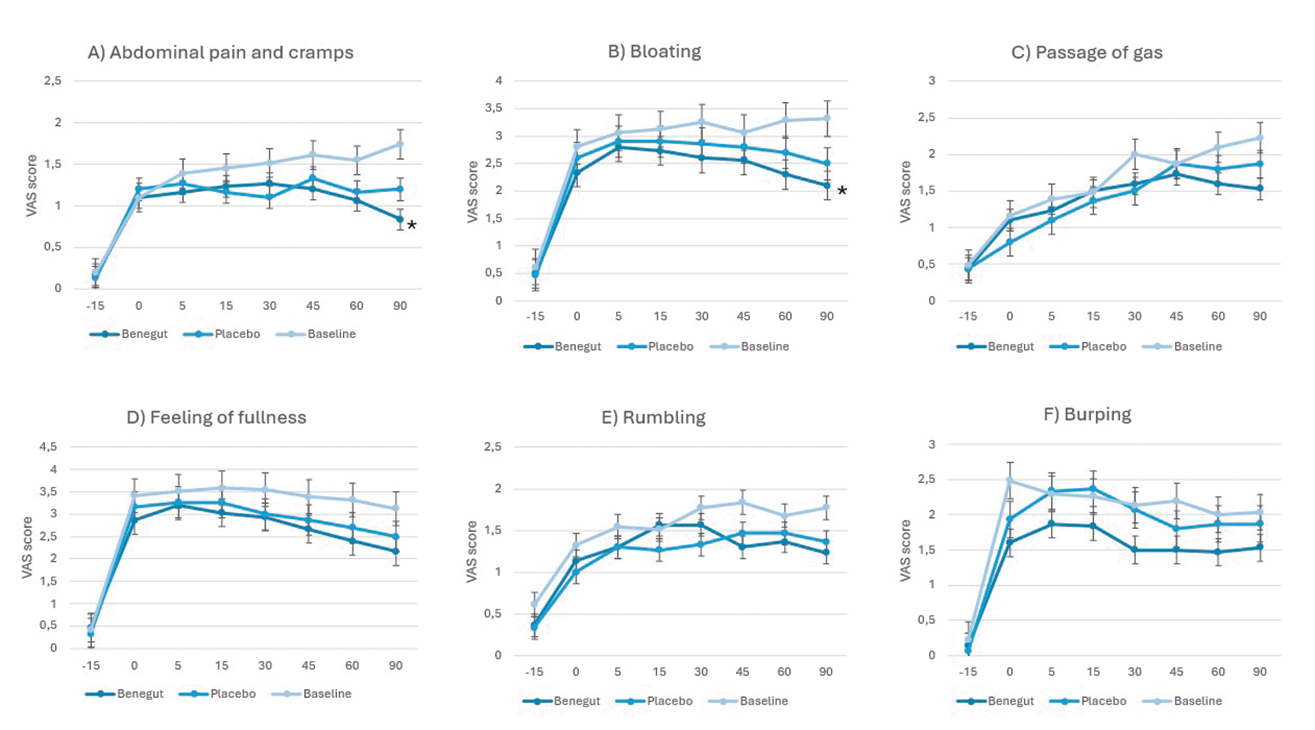
Figure 1. Curves representing the VAS score of symptoms at each time point represented by mean and SE for each group. A) Abdominal pain and cramps, B) Bloating, C) Passage of gas, D) Feeling of fullness, E) Rumbling, F) Burping. * significant difference between Benegut and Placebo at 90min.
Discussion
Upper GI discomfort is common after a high-calorie meal. Previous studies have shown that high-calorie meal consumption can significantly induce bloating, feeling of fullness and nausea (10, 11). We observed a similar trend in our study where during all the three visits, feeling of fullness, bloating and burping were the main symptoms noted. Supplementation with Perilla frutescens extract was associated with improvements in the main individual GI symptoms compared with the screening visit, while overall postprandial GI discomfort was lower than at both the screening and placebo visits, reaching statistical significance versus placebo. The polyphenolic mixture of rosmarinic acid and the flavonoid fraction in Perilla frutescens extract are expected to contribute to the alleviation of the symptoms that were observed in this study.
The majority of studies in the area of symptom relief for GI discomforts are based on probiotics and postbiotics. Although these solutions have shown promising results, these studies involve a chronic treatment period. Thus, there is a need for product development for acute symptom relief. Perilla frutescens extract, in a previous clinical trial, has displayed GI discomfort relief effects on a chronic set-up. Thus, the current study strengthens the previous one by offering proof on acute symptom relief. The aetiology of GI discomfort is multifactorial. We suggest that during chronic consumption of Perilla frutescens extract, the effect might be mediated via changes in gut microbiota and improvement of barrier function. Intestinal barrier dysfunction leading to increased infiltration of mast cells have been noted in cases of functional dyspepsia (12). Mast cells lead to proinflammatory cytokine release causing an acute inflammation potentially interfering with enteric nerve functions and increased visceral sensitivity (13). Interestingly, Perilla frutescens extract has shown to improve the intestinal barrier function measured with transepithelial electrical resistance in cell culture model (14).
Rosmarinic acid and apigenin components of Perilla frutescens extract have demonstrated beneficial gut barrier function in several preclinical models (15, 16). In mice with dextran sulphate sodium-induced colitis, apigenin was shown to enhance, apigenin has demonstrated to enhance the expressions of important gut barrier markers such as ZO-1, occludin, claudin-1, and claudin-3 (17).
Whilst chronic effects are potentially modified via gut microbiota and intestinal barrier, acute effects might be mitigated by altering visceral sensitivity, smooth muscle contractions and postprandial gut hormones. Visceral sensitivity affected by acute inflammation, gut hormones and nutrients modulate the communication of nociceptive information from GI tract to the brain (1). This leads to improper gastric emptying and therefore bloating. Postprandial state involves regulation of various hormones some of which are suggested to be altered in subjects with gastrointestinal disorders. Subjects with functional dyspepsia have been noted to have higher plasma cholecystokin (CCK) and lower ghrelin compared to healthy controls (11). Interestingly, apigenin found in seeds of Perilla frutescens has shown to inhibit food intake by acting on gut hormones (18).
Symptoms such as spasms and pain are induced by smooth muscle contractions in stomach and upper GI tract which are influenced by various pathways such as release of acetylcholine, excess influx of calcium ions etc. Inhibition of these pathways could offer antispasmodic effect. Interestingly, rosmarinic acid and vicenin-2 have displayed inhibition of acetylcholine receptors in rat ileum, thus acting as anti-spasmodic agents (19). Rosmarinic acid from Perilla frutescens extract have also shown attenuation of atropine- and dopamine-induced inhibition of gastric emptying and gastrointestinal motility in animal model (20). Excess entry of calcium ions from extracellular fluid incites smooth muscle contractions. Cucumis melo seeds, which are rich in flavonoids, such as apigenin, luteolin, quercetin and rutin, have displayed antispasmodic, antiperistalsis actions by blocking calcium ion channels thus reducing calcium influx into smooth muscle cells. We expect a similar mode of action from the supplement, which needs to be evaluated in future mechanistic studies.
Studies focusing on treatment for GI discomfort and functional GI disorders are prone to placebo effects. Accordingly, overall GI discomfort was also lower in the placebo group in comparison to screening, but not significant. As the study was powered and designed to evaluate the primary outcome, we did not see significance against placebo in iAUC of certain individual symptoms (burping, bloating and feeling of fullness). Future studies focusing on the triggers of GI discomfort and potential modes of action by Perilla frutescens extract would allow us to focus on individual symptoms as well.
Overall, these findings indicate that the extract of Perilla frutescens® provides acute postprandial relief of overall GI discomfort in healthy adults.
Author contributions
Conceptualization: SBW; Investigation CS, SBW; Methodology: CS, SBW; Data analysis: JM, CR; Supervision: CR, JC, SBW, KH; Writing and review of draft: JM, CR, JC, SBW, KH, AG.
References and notes
- Ford AC, Mahadeva S, Carbone MF, Lacy BE, Talley NJ. Functional dyspepsia. The Lancet. 2020 Nov 21;396(10263):1689–702. doi:10.1016/S0140-6736(20)30469-4
- Bisschops R, Karamanolis G, Arts J, Caenepeel P, Verbeke K, Janssens J, et al. Relationship between symptoms and ingestion of a meal in functional dyspepsia. Gut. 2008 Nov 1;57(11):1495. doi:10.1136/gut.2007.137125
- Agrawal A, Whorwell PJ. Review article: Abdominal bloating and distension in functional gastrointestinal disorders – Epidemiology and exploration of possible mechanisms. Aliment Pharmacol Ther. 2008 Jan;27(1):2–10. doi:10.1111/J.1365-2036.2007.03549.X PubMed PMID: 17931344.
- Corazziari E. Definition and epidemiology of functional gastrointestinal disorders. Best Pract Res Clin Gastroenterol. 2004;18(4):613–31. doi:https://doi.org/10.1016/j.bpg.2004.04.012
- Thurber KM, Otto AO, Stricker SL. Proton pump inhibitors: Understanding the associated risks and benefits of long-term use. American Journal of Health-System Pharmacy. 2023 Apr 15;80(8):487–94. doi:10.1093/ajhp/zxad009
- Kim YS, Kim JW, Ha NY, Kim J, Ryu HS. Herbal Therapies in Functional Gastrointestinal Disorders: A Narrative Review and Clinical Implication. Front Psychiatry [Internet]. 2020;11. Available from: https://www.frontiersin.org/articles/10.3389/fpsyt.2020.00601
- Ahmed HM. Ethnomedicinal, Phytochemical and Pharmacological Investigations of Perilla frutescens (L.) Britt. Molecules 2019, Vol 24, Page 102. 2018 Dec 28;24(1):102. doi:10.3390/MOLECULES24010102 PubMed PMID: 30597896.
- Buchwald-Werner S, Fujii H, Reule C, Schoen C. Perilla Extract improves gastrointestinal discomfort in a randomized placebo controlled double blind human pilot study. BMC Complement Altern Med. 2014 May 27;14(1):1–10. doi:10.1186/1472-6882-14-173/FIGURES/5 PubMed PMID: 24885816.
- Sperber AD, Bangdiwala SI, Drossman DA, Ghoshal UC, Simren M, Tack J, et al. Worldwide Prevalence and Burden of Functional Gastrointestinal Disorders, Results of Rome Foundation Global Study. Gastroenterology. 2021 Jan;160(1):99-114.e3. doi:10.1053/j.gastro.2020.04.014
- Levine ME, Koch SY, Koch and KL. Lipase Supplementation before a High-Fat Meal Reduces Perceptions of Fullness in Healthy Subjects. Gut Liver. 2015/07/31. 2015 Jul;9(4):464–9. doi:10.5009/gnl14005
- Pilichiewicz AN, Feltrin KL, Horowitz M, Holtmann G, Wishart JM, Jones KL, et al. Functional Dyspepsia Is Associated With a Greater Symptomatic Response to Fat But Not Carbohydrate, Increased Fasting and Postprandial CCK, and Diminished PYY. Official journal of the American College of Gastroenterology | ACG [Internet]. 2008;103(10). Available from: https://journals.lww.com/ajg/fulltext/2008/10000/functional_dyspepsia_is_associated_with_a_greater.28.aspx
- Komori K, Ihara E, Minoda Y, Ogino H, Sasaki T, Fujiwara M, et al. The Altered Mucosal Barrier Function in the Duodenum Plays a Role in the Pathogenesis of Functional Dyspepsia. Dig Dis Sci. 2019 Nov 1;64(11):3228–39. doi:10.1007/S10620-019-5470-8/METRICS PubMed PMID: 30673985.
- Yoo BB, Mazmanian SK. The Enteric Network: Interactions between the Immune and Nervous Systems of the Gut. Immunity. 2017 Jun 6;46(6):910. doi:10.1016/J.IMMUNI.2017.05.011 PubMed PMID: 28636959.
- Buchwald-Werner S, Luscher S, Kudo S, Butterweck V. Perilla Frutescens targets intestinal permeability In vitro study on TNF-alpha stress-induced barrier dysfunction in intestinal epithelial cells. Agro Food Ind Hi Tech. 2016;27(5):13–6.
- Mascaraque C, González R, Suárez MD, Zarzuelo A, De Medina FS, Martínez-Augustin O. Intestinal anti-inflammatory activity of apigenin K in two rat colitis models induced by trinitrobenzenesulfonic acid and dextran sulphate sodium. Br J Nutr. 2015 Feb 28;113(4):618–26. doi:10.1017/S0007114514004292 PubMed PMID: 25654996.
- Radulovic K, Normand S, Rehman A, Delanoye-Crespin A, Chatagnon J, Delacre M, et al. A dietary flavone confers communicable protection against colitis through NLRP6 signaling independently of inflammasome activation. Mucosal Immunol. 2018 May 1;11(3):811–9. doi:10.1038/mi.2017.87 PubMed PMID: 29139477.
- Hu Y, Guan X, He Z, Xie Y, Niu Z, Zhang W, et al. Apigenin-7-O-glucoside alleviates DSS-induced colitis by improving intestinal barrier function and modulating gut microbiota. J Funct Foods. 2023 May 1;104:105499. doi:10.1016/J.JFF.2023.105499
- Myoung HJ, Kim G, Nam KW. Apigenin isolated from the seeds of perilla frutescens britton var crispa (Benth.) inhibits food intake in C57BL/6J mice. Arch Pharm Res. 2010 Dec 30;33(11):1741–6. doi:10.1007/S12272-010-1105-5/METRICS PubMed PMID: 21116776.
- Verspohl EJ, Fujii H, Homma K, Buchwald-Werner S. Testing of Perilla frutescens extract and Vicenin 2 for their antispasmodic effect. Phytomedicine. 2013 Mar 15;20(5):427–31. doi:10.1016/J.PHYMED.2012.12.018 PubMed PMID: 23357362.
- Kimura Y, Taniguchi M. Effects of Perilla frutescens var. crispa herb extract, the essential oil perillaldehyde, and the caffeetannin rosmarinic acid on gastric emptying and gastrointestinal motility in mice. Traditional & Kampo Medicine. 2021 Dec 1;8(3):194–203. doi:10.1002/TKM2.1296

The Anatomy of a Paradox and a Need for Real-World Evidence

The timeless skin revolution: how Indena’s botanical innovations...

PEER REVIEWED – New evidence supports plant-based sources in clo...

How GLP-1 is reshaping food supplements

Beyond Longevity: the new frontier of healthy aging with full spectrum...

The Blueprint — How Functional Ingredients Pioneered the Digital Decen...

Probiotic Human Study Design and Reporting (PRODARE): improving probio...

Insights from the 19th International Scientific Conference on Probioti...