
Introduction
Weight regulation is increasingly understood as the product of interacting metabolic, neuroendocrine and behavioural pathways that are highly conserved across mammalian species and function collectively to maintain stable energy reserves (1). A central component of this regulatory network is glucose handling after meal ingestion. Postprandial glucose (PPG) excursions act as a primary metabolic signal, coordinating communication between the gastrointestinal tract, the central nervous system and adipose tissue (2). When glucose enters the circulation rapidly, pancreatic βcells generate a proportionally large insulin response, engaging Gproteincoupled receptor pathways and downstream metabolic processes that influence substrate use, energy availability and appetite regulation (3). Over time, repeated exposure to exaggerated glycaemic and insulinemic responses contributes to metabolic inflexibility, heightened hunger drive and progressive adiposity (4). Together, these processes highlight the importance of moderating PPG dynamics; however, achieving this consistently through dietary modification alone is challenging in modern food environments (5). Even structured interventions such as lowcarbohydrate, ketogenic or timerestricted eating often fail due to behavioural, environmental and physiological pressures (6).
The recent clinical success of glucagonlike peptide1 receptor agonists (GLP1 RAs), which influence PPG handling alongside delayed gastric emptying and central appetite regulation, underscores the importance of glucose–insulin dynamics within broader weightregulatory pathways. GLP1-RA reduce energy intake through delayed gastric emptying, and direct central appetiteregulatory effects while also enhancing glucosedependent insulin secretion (7). In parallel, rising public awareness of metabolic health has created new opportunities, with consumers increasingly seeking accessible, nutritionbased approaches that complement medical therapies. This has intensified interest in interventions that attenuate PPG excursions in ways compatible with realworld eating patterns. Among these, botanical modulators of carbohydrate digestion, such as mulberry leaf extract (MLE), have increasing interest because its iminosugar constituents can competitively inhibit intestinal α-glucosidase, thereby slowing carbohydrate digestion and reducing the rate of postprandial glucose appearance.
This review synthesises mechanistic, clinical and behavioural evidence linking postprandial glucose–insulin dynamics to weight regulation and evaluates the role of MLE as a botanical strategy for moderating postprandial carbohydrate handling.
Postprandial Glucose and Insulin Dynamics in Weight Regulation
Postmeal glucose handling exerts immediate and downstream effects on appetite, energy stability and substrate utilisation. Rapid glucose absorption stimulates a steep insulin response, which, while essential for glucose clearance, simultaneously suppresses lipolysis, inhibits fattyacid oxidation and promotes nutrient storage across hepatic, muscular and adipose compartments. Insulin acts as the master regulator of postprandial metabolism, coordinating glucose uptake, hepatic glucose production, adipose tissue lipolysis and protein turnover (8). These metabolic effects are tightly coupled to neuroendocrine pathways. Glycaemic excursions modulate secretion of GLP1, glucosedependent insulinotropic polypeptide (GIP), peptide YY (PYY) and ghrelin, altering hypothalamic and mesolimbic circuits that govern hunger, reward and satiety (7). When glucose rises sharply and falls rapidly, these hormonal oscillations amplify hunger and drive compensatory eating. Leptin–GLP1 interactions further modulate these responses, with leptin resistance attenuating GLP1mediated hypophagia (9). These mechanisms align with broader neurobiological models of weight regulation (1).
Interindividual variability in postprandial responses is substantial. Studies integrating continuous glucose monitoring (CGM) with microbiome profiling demonstrate that gut microbial composition is a major determinant of glycaemic variability, influencing both glucose absorption and insulin sensitivity (10). Machinelearning models further show that personalised glycaemic responses predict weightgain susceptibility and can be used to tailor personalised dietary interventions (11). Stabilising PPG is not merely a glycaemic objective, it is a behavioural and metabolic objective, reducing hunger, improving energy stability and supporting fat loss.
Mechanistic Pathways Linking Glycaemic Spikes to Adiposity
Postprandial glycaemic spikes influence adiposity through interconnected metabolic and neuroendocrine pathways (Figure 1).
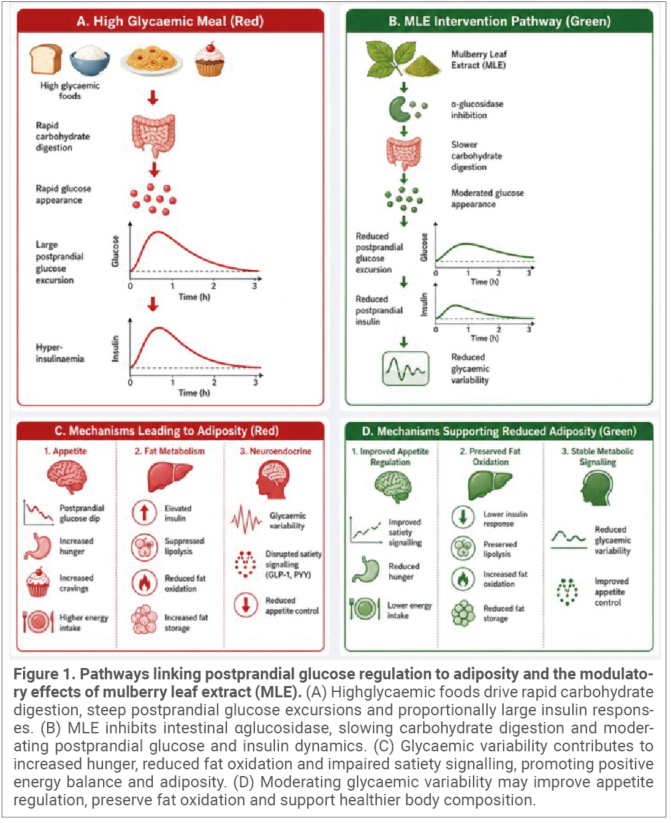
Beyond these hostdriven mechanisms, the microbial ecosystem strongly influences postprandial glycaemia. Microbial metabolites such as shortchain fatty acids regulate intestinal glucose absorption by modulating SGLT1 and GLUT2 expression, while also enhancing hepatic and peripheral insulin sensitivity through G-protein-coupled receptor (GPCR)mediated pathways, a major signalling family involved in metabolic regulation.
Dysbiosis increases intestinal permeability and lowgrade inflammation, impairing insulin action and amplifying the glycaemic response to identical meals. Microbial composition also shapes bileacid pools, which regulate GLP1 secretion via G protein-coupled bile acid receptor 1 (TGR5) and farnesoid X receptor (FXR) signalling, thereby altering the incretin response and downstream insulin dynamics. Together, these microbe–host interactions determine both the height of glycaemic excursions and the metabolic fate of absorbed nutrients, linking microbiome structure directly to adiposity risk (10).
Glycaemic Variability, Appetite Regulation and Long-Term Weight Gain
Weight gain requires sustained positive energy balance, but the physiological mechanisms shaping energy intake are more closely tied to postprandial metabolism than is often appreciated.
Beyond their role in glucose homeostasis, PPG and postprandial insulin (PPI) excursions influence appetite regulation, food reward, energy stability and subsequent eating behaviour (7).
After consuming rapidly digestible carbohydrates, blood glucose rises sharply, eliciting a proportionally large insulin response. Although this response is necessary for glucose disposal, the resulting decline in circulating glucose can, in some individuals, lead to a postprandial glucose dip below baseline levels. Emerging evidence suggests that these glucose dips are associated with increased hunger, earlier initiation of subsequent meals and greater energy intake over the remainder of the day (13). Analysis of over 1,000 participants in the PREDICT study demonstrated that larger postprandial glucose declines were associated with significantly increased hunger and greater caloric consumption, independent of meal composition (13).
These findings provide a mechanistic framework linking glycaemic variability to weight gain. PPG excursions are associated with appetite dysregulation and may contribute to behavioural patterns that favour weight gain. Repeated cycles of rapid glucose excursions followed by exaggerated insulin responses and subsequent glucose declines may promote compensatory eating behaviours, increase daily energy intake and contribute to positive energy balance. Studies also show substantial inter-individual variability in postprandial glycaemic responses, influenced by insulin sensitivity, meal composition, gastric emptying, and gut microbiota composition (10, 11). Individuals exhibiting greater glycaemic variability may therefore be particularly susceptible to appetite dysregulation and weight gain.
Importantly, longitudinal evidence suggests that disturbances in postprandial glucose and insulin handling may precede the development of obesity-related metabolic dysfunction. In a four-year prospective study, individuals who gained weight demonstrated progressive increases in energy intake, fasting insulin concentrations and insulin resistance, whereas weight-stable individuals maintained greater metabolic stability and dietary quality (5). These findings suggest that repeated exposure to exaggerated PPI responses may contribute to the behavioural and metabolic adaptations that favour long-term weight gain. Collectively, these data support the concept that controlling the rate of glucose appearance following meals represents not only a strategy for improving glycaemic outcomes but also a means of influencing appetite regulation, energy intake and body-weight trajectories.
Targeting Postprandial Glucose as a Lever for Weight Management
The links between glycaemic variability, appetite, and weight-gain susceptibility make PPG a clear intervention target. By slowing the rate of glucose appearance and reducing insulin demand, interventions targeting postprandial metabolism may help preserve fat oxidation, improve metabolic flexibility and support appetite control (13).
A variety of nutritional approaches have been investigated to achieve this objective. Gut-based strategies, including delayed gastric emptying, inhibition of α-glucosidase activity and modulation of intestinal glucose transport, have all been shown to reduce postprandial glycaemia (1). While dietary carbohydrate restriction can achieve similar effects, long-term adherence is often challenging in free-living populations (6, 14). Interventions that moderate glucose appearance without requiring substantial dietary change may offer a practical means of influencing one of the earliest physiological drivers of weight gain susceptibility.
Botanical Interventions for Modulating Carbohydrate Digestion
A range of botanicals has been investigated for their ability to modulate carbohydrate digestion, primarily through inhibition of α-amylase or α-glucosidase. However, many demonstrate variable potency, inconsistent standardisation or limited reproducibility in human studies. Ascophyllum nodosum and Fucus vesiculosus contain polyphenols and phlorotannins with α-amylase and α-glucosidase inhibitory activity, yet human trials frequently report no meaningful effects on PPG excursions (15). White kidney bean extract (Phaseolus vulgaris) contains phaseolamin, an α-amylase inhibitor that binds the enzyme responsible for breaking complex carbohydrates into absorbable sugars, It reduces starch digestion and absorption and blunts the post-meal glucose rise (16). Similarly, Salacia species supply salacinol and kotalanol, potent α-glucosidase inhibitors in vitro, though gastrointestinal intolerance and variable clinical efficacy limit their translational relevance (17).
Beyond enzyme inhibition, several botanicals modulate PPG through insulinotropic pathways. Trigonella foenumgraecum (fenugreek) contains 4hydroxyisoleucine, an amino acid that enhances glucosestimulated insulin secretion and activates components of the insulinsignalling pathway, contributing to improved PPG handling (18). Momordica charantia (bitter melon) provides cucurbitanetype triterpenoid saponins that stimulate insulin secretion in vitro and may enhance βcell responsiveness (19). While these insulinotropic botanicals demonstrate glucoselowering potential, their effects are often modest, variable across preparations, and dependent on preserved βcell function.
Within this heterogeneous landscape of carbohydrate-modulating botanicals, Morus alba (white mulberry) offers a well-characterised and clinically reproducible mechanism for moderating postprandial glycaemia. Ntalouka and Tsirivakou (2024) identify Morus alba as one of the few botanicals with convergent evidence across invitro, invivo and human models, demonstrating reproducible reductions in postprandial glucose and improvements in adiposityrelated markers (20).
Mechanistic basis of MLE standardised to iminosugars
MLE formulations that modulate carbohydrate digestion act primarily through competitive inhibition of intestinal α-glucosidase. A representative example is Reducose®, a patented waterextracted MLE standardised to its alkaloid content, carbohydrate-mimetic compounds iminosugars such as 1-deoxynojirimycin. Such formulations delay the hydrolysis of dietary disaccharides and polysaccharides into absorbable monosaccharides.
Through competitive inhibition of intestinal α-glucosidase, MLE slows the breakdown of disaccharides and starchderived oligosaccharides. Undigested carbohydrates move into the distal small intestine, where colonic microbiota gradually hydrolyse or partially ferment them. The inhibitory action of iminosugars such as 1DNJ is transient, limited to the meal in which they are consumed, and these compounds are rapidly cleared without systemic accumulation. The magnitude of inhibition differs by substrate, with stronger effects on sucrose and starchderived oligosaccharides than on free glucose.
By slowing carbohydrate breakdown at the intestinal brush border, the rate of glucose appearance in the circulation is reduced, resulting in smaller PPG excursions, lower insulin exposure (21, 22, 23).
Bioactive molecules found in mulberry leaf have been shown in cellular and animal models to modulate insulin signalling (IRS1/PI3K/Akt), enhance GLUT4 translocation and activate AMPK, supporting healthy insulin signalling and mitochondrial function (24). These effects promote a more favourable metabolic state.
Clinical evidence for standardised mulberry leaf extract
A review of the published clinical literature of the published clinical literature identified multiple randomized, controlled studies examining the effects of a specific standardized, water-extracted MLE preparation (Reducose®) on PPG and PPI responses across a range of carbohydrate challenges and populations. In healthy adults, the MLE formulation significantly reduced glucose and insulin area under the curve following maltodextrin and sucrose ingestion (21, 25), and in normoglycaemic individuals it reduced glucose and insulin exposure, without compensatory hyperinsulinaemia, indicating a more favourable acute postprandial glucose–insulin response (25). Controlled human studies of standardised MLE preparations have reported acute reductions in PPG and PPI exposure approaching 40% (21, 22, 23, 25). A clear dose response relationship has also been demonstrated, with higher doses producing progressively greater reductions in both glucose and insulin responses following a mixed meal challenge (22). However, the magnitude of improvement begins to plateau beyond 250 mg, which already achieves 42% reductions in both glucose and insulin incremental area under the curve. This supports 250 mg as an effective and practical dose for attenuating PPG excursions in real-world settings.
This pattern is further supported by glycaemic index testing, where MLE produced dose-dependent reductions in the glycaemic impact of white bread (26, 27). Similar postprandial effects have also been reported in a study involving individuals with type 2 diabetes, where the MLE preparation was associated with favourable changes in postprandial glucose and insulin response (28), suggesting that its acute effects may be observed across populations with different baseline metabolic characteristics. Evidence for acute reductions in PPG and PPI is robust, with findings related to appetite and body-composition outcomes emerging and should be interpreted as supportive rather than conclusive. Beyond its effects on PPG, MLE has demonstrated meaningful benefits for appetite regulation and weightrelated outcomes, reflecting the central role of glucose–insulin dynamics in shaping hunger, satiety and substrate utilisation (29).
Stabilising PPG reduces the steep insulin excursions that suppress fat oxidation and drive rebound hunger, thereby supporting a metabolic environment more favourable to sustained energy balance. Human studies show improvements in appetite regulation by reducing subjective hunger and enhances satiety signalling (29), consistent with its ability to blunt rapid glucose appearance and the associated hormonal volatility across the gut–brain–adipose axis. Shortterm supplementation has also been associated with improvements in adiposityrelated markers in overweight adults (30), with several anthropometric and bodycomposition changes emerging only during the period in which the MLE formulation was introduced. Although exploratory and nonrandomised, these temporal patterns suggest that moderating postprandial glycaemic load may translate into downstream effects on body composition. Collectively, these findings align with the mechanistic expectation that reducing glycaemic variability preserves fat oxidation, lowers compensatory energy intake and supports behavioural patterns conducive to weight management. In this context, the reviewed data support the role of this defined MLE formulation as a practical, welltolerated nutritional strategy for helping modulate postprandial carbohydrate handling, with relevance to appetite and weight-management strategies.
Conclusion
PPG and PPI dynamics sit at the centre of metabolic regulation and weight trajectories. Botanical extracts that slow carbohydrate breakdown, including MLE, modulate these early signals in a manner distinct from insulinpriming or incretinbased therapies. Their meallevel mechanism offers a practical route to reducing glycaemic volatility, with emerging evidence supporting effects on appetite and adiposityrelated markers. Further research should examine longterm effects on body composition, metabolic flexibility, and behavioural outcomes, as well as interactions with dietary patterns, microbiomemediated glycaemic responses, and emerging metabolic interventions.
References and notes
- Burger KS, Shearrer GE, Sanders AJ. Brain-based etiology of weight regulation. Curr Diab Rep. 2015;15(11):100. Available from: https://www.ncbi.nlm.nih.gov/pubmed/26399983.
- Morton GJ, Meek TH, Schwartz MW. Neurobiology of food intake in health and disease. Nat Rev Neurosci. 2014;15(6):367–78.Availble from: https://doi.org/10.1038/nrn3745
- Ahrén B. Islet G protein-coupled receptors as potential targets for treatment of type 2 diabetes. Nature Reviews Drug Discovery. 2009;8(5):369–85. Available from: https://doi.org/10.1038/nrd2782.
- Ludwig DS, Aronne LJ, Astrup A, de Cabo R, Cantley LC, Friedman MI, et al. The carbohydrate-insulin model: a physiological perspective on the obesity pandemic. The American Journal of Clinical Nutrition. 2021;114(6):1873–85. Available from: https://www.sciencedirect.com/science/article/pii/S0002916522005172.
- Hall KD, Ayuketah A, Brychta R, Cai H, Cassimatis T, Chen KY, et al. Ultra-Processed Diets Cause Excess Calorie Intake and Weight Gain: An Inpatient Randomized Controlled Trial of Ad Libitum Food Intake. Cell Metabolism. 2019;30(1):67–77.e3. Available from: https://www.sciencedirect.com/science/article/pii/S1550413119302487.
- Lowe DA, Wu N, Rohdin-Bibby L, Moore AH, Kelly N, Liu YE, et al. Effects of Time-Restricted Eating on Weight Loss and Other Metabolic Parameters in Women and Men With Overweight and Obesity: The TREAT Randomized Clinical Trial. JAMA Internal Medicine. 2020;180(11):1491–9. Available from: https://doi.org/10.1001/jamainternmed.2020.4153.
- Pfeiffer AF, Wefers J, Quast D, Nauck M. The evolving story of incretins (GIP and GLP‐1) in metabolic and cardiovascular disease: A pathophysiological update. Diabetes, Obesity and Metabolism. 2021;23(S3):5–29.
- Norton L, Shannon C, Gastaldelli A, DeFronzo RA. Insulin: The master regulator of glucose metabolism. Metabolism. 2022;129:155142. Available from: https://www.sciencedirect.com/science/article/pii/S0026049522000208.
- Burmeister MA, Ayala J, Drucker DJ, Ayala JE. Central glucagon-like peptide 1 receptor-induced anorexia requires glucose metabolism-mediated suppression of AMPK and is impaired by central fructose. Am J Physiol Endocrinol Metab. 2013;304(7):E677–85. Available from: https://doi.org/10.1152/ajpendo.00446.2012
- Armet AM, Li F, Deehan EC, Nikolaeva DD, Delannoy-Bruno O, Siegwald L, et al. Mechanistic insights into microbiome-dependent and personalized responses to dietary fibre in a randomized controlled trial. medRxiv. 2025. Available from: 10.1101/2025.11.20.25340625
- Zeevi D, Korem T, Zmora N, Israeli D, Rothschild D, Weinberger A, et al. Personalized Nutrition by Prediction of Glycemic Responses. Cell. 2015;163(5):1079–94. Available from: https://doi.org/10.1016/j.cell.2015.11.001.
- Galgani J, Ravussin E. Energy metabolism, fuel selection and body weight regulation. International Journal of Obesity. 2008;32(7):S109–S19. Available from: https://doi.org/10.1038/ijo.2008.246.
- Berry S, Wyatt P, Franks P, Blundell J, O’Driscoll R, Wolf J, et al. Effect of Postprandial Glucose Dips on Hunger and Energy Intake in 1102 Subjects in US and UK: The PREDICT 1 Study. Current Developments in Nutrition. 2020;4:nzaa063_09. Available from: https://www.sciencedirect.com/science/article/pii/S2475299123096294.
- King A, Desai M, Ioannidis JP, Rigdon J, Hauser M, Del Gobbo L, et al. Effect of Low-Fat vs Low-Carbohydrate Diet on 12-Month Weight Loss in Overweight Adults and the Association With Genotype Pattern or Insulin Secretion: The DIETFITS Randomized Clinical Trial. JAMA. 2018;319(7):667–79. Available from: https://jamanetwork.com/journals/jama/fullarticle/2673150
- Vodouhè M, Marois J, Guay V, Leblanc N, Weisnagel SJ, Bilodeau JF, et al. Marginal Impact of Brown Seaweed Ascophyllum nodosum and Fucus vesiculosus Extract on Metabolic and Inflammatory Response in Overweight and Obese Prediabetic Subjects. Mar Drugs. 2022;20(3). Available from: https://doi.org/10.3390/md20030174
- Udani J, Tan O, Molina J. Systematic Review and Meta-Analysis of a Proprietary α-Amylase Inhibitor from White Bean (Phaseolus vulgaris L.) on Weight and Fat Loss in Humans. Foods. 2018;7(4).
- Williams JA, Choe YS, Noss MJ, Baumgartner CJ, Mustad VA. Extract of Salacia oblonga lowers acute glycemia in patients with type 2 diabetes2, 3. The American Journal of Clinical Nutrition. 2007;86(1):124–30. Available from: https://www.sciencedirect.com/science/article/pii/S0002916523274596.
- Vijayakumar MV, Singh S, Chhipa RR, Bhat MK. The hypoglycaemic activity of fenugreek seed extract is mediated through the stimulation of an insulin signalling pathway. Br J Pharmacol. 2005;146(1):41–8. Available from: https://doi.org/10.1038/sj.bjp.0706312
- Keller AC, Ma J, Kavalier A, He K, Brillantes AM, Kennelly EJ. Saponins from the traditional medicinal plant Momordica charantia stimulate insulin secretion in vitro. Phytomedicine. 2011;19(1):32–7. Available from: 10.1016/j.phymed.2011.06.019
- Ntalouka F, Tsirivakou A. Morus alba: natural and valuable effects in weight loss management. Front Clin Diabetes Healthc. 2024;5:1395688. Available from: https://doi.org/10.3389/fcdhc.2024.1395688
- Thondre PS, Lightowler H, Ahlstrom L, Gallagher A. Mulberry leaf extract improves glycaemic response and insulaemic response to sucrose in healthy subjects: results of a randomized, double blind, placebo-controlled study. Nutr Metab (Lond). 2021;18(1):41. Available from: https://doi.org/10.1186/s12986-021-00571-2
- Thondre PS, Butler I, Tammam J, Achebe I, Young E, Lane M, et al. Understanding the Impact of Different Doses of Reducose((R)) Mulberry Leaf Extract on Blood Glucose and Insulin Responses after Eating a Complex Meal: Results from a Double-Blind, Randomised, Crossover Trial. Nutrients. 2024;16(11). Available from: https://www.ncbi.nlm.nih.gov/pubmed/38892603.
- Gheldof N, Francey C, Rytz A, Egli L, Delodder F, Bovetto L, et al. Effect of Different Nutritional Supplements on Glucose Response of Complete Meals in Two Crossover Studies. Nutrients. 2022;14(13). Available from: https://www.ncbi.nlm.nih.gov/pubmed/35807854.
- Zhang Y, Li L, Chai T, Xu H, Du H-y, Jiang Y. Mulberry leaf multi-components exert hypoglycemic effects through regulation of the PI-3K/Akt insulin signaling pathway in type 2 diabetic rats. Journal of Ethnopharmacology. 2024;319:117307. Available from: https://www.sciencedirect.com/science/article/pii/S0378874123011777.
- Lown M, Fuller R, Lightowler H, Fraser A, Gallagher A, Stuart B, et al. Mulberry-extract improves glucose tolerance and decreases insulin concentrations in normoglycaemic adults: Results of a randomised double-blind placebo-controlled study. PLoS One. 2017;12(2):e0172239. Available from: https://doi.org/10.1371/journal.pone.0172239
- Ding F, Wang Q, Xie C, Wang M, Zhang L, Gao M, et al. The impact of mulberry leaf extract at three different levels on reducing the glycemic index of white bread. PLoS One. 2023;18(8):e0288911. Available from: https://doi.org/10.1371/journal.pone.0288911
- Wang R, Li Y, Mu W, Li Z, Sun J, Wang B, et al. Mulberry leaf extract reduces the glycemic indexes of four common dietary carbohydrates. Medicine. 2018;97(34):e11996. Available from: https://doi.org/10.1097/MD.0000000000011996
- Mohamed M, Zagury RL, Bhaskaran K, Neutel J, Mohd Yusof BN, Mooney L, et al. A Randomized, Placebo-Controlled Crossover Study to Evaluate Postprandial Glucometabolic Effects of Mulberry Leaf Extract, Vitamin D, Chromium, and Fiber in People with Type 2 Diabetes. Diabetes Ther. 2023;14(4):749–66. Available from: https://doi.org/10.1007/s13300-023-01379-4
- Hester S, Gray R, Wood S. P31-024-23 Effects of a Dietary Supplement Focused on Blood Glucose Control To Assist in Weight Management That Impacts Appetite, Hunger, and Satiety. Current Developments in Nutrition. 2023;7:101589. Available from: P31-024-23
- Panunzio A, Tafuri A, Nicastro V, Ieva R, Fariello S. Short-term supplementation with Morus alba leaf extract: Glycaemic and adiposity-related outcomes in overweight adults. Journal of Functional Foods. 2026;141:107315. Available from: https://www.sciencedirect.com/science/article/pii/S1756464626001659.

From Soil Health to Business Resilience: Why Sustainability is no Long...

Complete Gut Health Solutions One Ecosystem. Seven Science-Led Strateg...

Peer-reviewed – Prebiotic Efficacy of a Fiber-Polyphenol Complex...

The Blueprint – How Functional Ingredients Pioneered the Digital...

A Word With – Reyhan Nergiz Unal and Yingying Wu – PB Leiner

Peer-reviewed – Development of Plant-Based Sodium Alginate-Aloe...

A Word With – Shaheen Majeed – CEO & Managing Director, Sab...

Peer-reviewed – Probiotic yeasts for gut microbiota and immune d...