
Introduction
Global livestock production is undergoing a fundamental transformation, shifting away from the use of antibiotics and synthetic growth promoters toward preventive strategies for maintaining animal health. This transition is being driven by increasingly stringent regulations on antimicrobial use. Ukraine is no exception: as part of the harmonization of its legislation with European Union requirements, stricter regulations governing antibiotic use in livestock production have been implemented since March 2026. Consequently, there is an increasing need for effective nutritional and biotechnological approaches that support animal health, productivity, and disease resistance under antibiotic-free production systems.
Meeting the increasing demand for safe, high-quality poultry products requires strategies that maintain gut health and immune resilience without relying on antibiotics. To address this need, investigation of the effects of yeast-based probiotics on gut microbiota activity, short-chain fatty acid production, and immune responses in broiler chickens is of growing scientific and practical importance in feed research.
Intensive broiler production requires not only high growth performance but also a stable health status of the flock. A major challenge is the increasing impact of environmental and physiological stressors, including heat, microbial, and oxidative stress, which can reduce growth rates, impair gut function, and increase susceptibility to infections. For example, heat stress can lead to reduced feed intake, up to a 9.7% decrease in protein digestibility, and a 32% decline in energy efficiency (1, 2).
The increasing intensity of poultry production, together with the growing demand for non-conventional products such as free-range and organic birds, is associated with a higher incidence of disease and an elevated risk of foodborne infections, particularly those involving antimicrobial-resistant pathogens. These concerns have raised important questions regarding the use of antimicrobial agents for disease prevention and control in poultry production (3-6).
However, the excessive use of antibiotics for prophylactic and nutritional purposes has raised concerns about the development of antimicrobial resistance, prompting some countries to ban their use, while in others measures to restrict and eventually prohibit them are still underway. Accordingly, these safety measures, including the withdrawal of antibiotics, are becoming increasingly important (7-9).
This shift creates a pressing need for new biotechnological solutions that can support gut health, microbiome stability, and immune function in poultry without relying on antibiotics. One promising approach is the use of yeast-based products, including probiotics, postbiotics, and prebiotics, to enhance resilience under production stress (10-12).
Despite increasing interest in yeast-based probiotics, a critical scientific gap remains., Although several yeast strains have been proposed as probiotics, their effects on gut microbiota composition, short-chain fatty acid production, and immune modulation in broilers raised under antibiotic-free conditions are not fully understood. Therefore, this study aims to evaluate the effects of a newly selected Kluyveromyces marxianus-based probiotic, compared with a Saccharomyces cerevisiae-based probiotic, on SCFA production and immune parameters in broilers.
Probiotics are living microorganisms that can serve as alternatives to antibiotics by supporting the gastrointestinal microbiota of host animals when administered in appropriate quantities (13). They help create an environment favorable to beneficial bacteria by adhering to the intestinal epithelium, which helps lower pH and neutralize toxins (14).
Probiotics enhance nutrient absorption through several mechanisms. They colonize and adhere to the intestinal mucosa, particularly in the small intestine where villi maximize the surface area (15), fostering a beneficial habitat by interacting with the protective mucus layer (12).
Two types of live microorganisms are fed to poultry: yeasts and bacteria, although most conventional probiotics are of bacterial origin (16). More recently, several yeast strains have been identified as promising probiotic candidates, as reflected in a growing number of publications over the last decades. Saccharomyces cerevisiae boulardii has been shown to be effective in mitigating pathological disorders in humans and animals, including broiler chickens. With advances in biotechnology, in addition to these well-known strains, new yeast strains with potential probiotic properties are being actively studied and introduced into poultry nutrition. Among them is Kluyveromyces marxianus.
Kluyveromyces marxianus is a versatile non-conventional yeast species that can be isolated from a variety of natural environments, including fermented dairy products, kefir grains, sugar industry wastewater, sisal leaves, and plants. It produces diverse metabolites and has applications in food biotechnology and agricultural production.
Kluyveromyces marxianus exhibits cholesterol-reducing activity, antiproliferative effects on cancer cells, immunomodulatory action in Caco-2 cells, and antimicrobial activity against various pathogenic species. However, its anticandidal activity has not been extensively studied and has been reported only for a single K. marxianus strain isolated from French cheese (17).
Probiotics support host health through a variety of mechanisms, including the enhancement of innate and acquired immunity (18). Innate immunity is modulated by regulating macrophages and leukocytes (19). Probiotics can also help balance the intestinal microflora (20) and reduce the production of harmful microbial metabolites in the gut, such as ammonia, hydrogen sulfide, and indoles (21).
In this study, we evaluated a newly selected Kluyveromyces marxianus-based probiotic that was isolated from dairy substrates (cow’s milk and cheese), identified, and characterized at the R&D center of Enzym Group (22). Following preliminary safety and technological assessments, the strain was scaled up to production scale. The probiotic requires further validation through field trials to confirm its efficacy in supporting gut microbiota and immune resilience in broilers raised under NAE conditions. Its effects were compared with those of another yeast-based probiotic containing Saccharomyces cerevisiae, which has been previously evaluated in livestock nutrition. Based on our previous studies and experience with the use of probiotic yeasts in experimental trials, we selected a supplementation level of 0.05% probiotics in the diet. This inclusion rate represents a conventional, intermediate, and effective dosage commonly used for such products.
One of the primary aims of this study was to determine the effects of probiotic yeast supplementation on the production of short-chain fatty acids (SCFAs) in broilers. SCFA concentrations are widely used as indicators of a healthy and balanced gut microbiota, reflecting the activity of beneficial microbial populations responsible for their synthesis. Another key objective was to evaluate whether these probiotic strains enhance humoral immune responses and to assess their effects on the phagocytic component of innate immunity.
Materials and methods
Experimental design
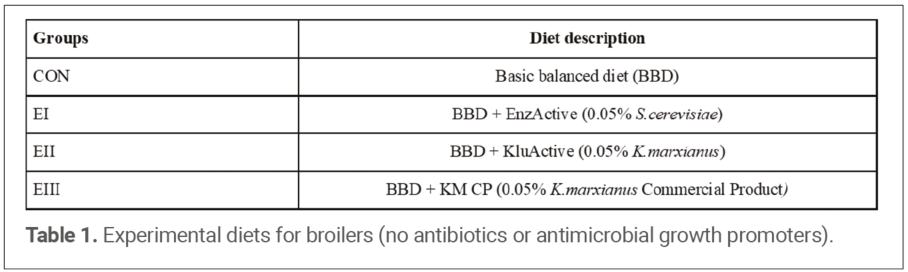
A total of 60 Ross 308 chicks (14 days old) with similar initial weight were divided into four replicates (experimental units) of 15 birds each and assigned to: one of three experimental diets and control diet (totally 4 groups). Broilers were raised for 43 days according to the experimental design and probiotic supplementation scheme (Table 1).
Chickens received probiotic products based on Kluyveromyces marxianus (KluActive, Enzym Group) and Saccharomyces cerevisiae (EnzActive, “Enzym Group”) strains in addition to their balanced diets.
The dietary treatments and ration formulations for each experimental group are presented in Table 1.
The health and vitality of the birds were monitored twice daily, and a post-mortem examination was performed on all animals at the end of the trial. Blood samples were collected on days 14 and 28 (days of trial = 28 and 43 days ages) for further analysis. All animal procedures were conducted in accordance with European Union regulations (EU Council. Directive 86/609/EEC on the Protection of Animals Used for Experimental and Other Scientific Purposes, 1986).
Blood sampling
On days 14 and 28 of the trial, blood samples were collected into EDTA anticoagulated tubes. Aliquots of each sample were immediately used for the determination of biochemical and immunological parameters. The remaining volume was centrifuged, and the plasma was collected and stored at −80 °C for subsequent enzymatic and chemical analyses.
Phagocytic activity (PA)
Phagocytic activity was assessed by determining the proportion of leukocytes capable of internalizing bacterial cells. A minimum of 100 phagocytic cells (heterophils and monocytes) were examined under light microscopy. PA was expressed as the percentage of phagocytes containing at least one engulfed bacterium.
Phagocytic number (PN)
The phagocytic number quantifies the intensity of phagocytosis by measuring the average number of bacteria ingested by active phagocytes. For each smear, the number of engulfed bacteria was counted in 50 phagocytic cells. PN was calculated as the mean number of S. aureus cells internalized per phagocyte.
Phagocytic index (PI)
The phagocytic index reflects the overall phagocytic capacity and combines both the proportion of active phagocytes and the number of bacteria ingested. This index provides an integrated measure of functional phagocyte activity (23-25).
Serum Lysozyme activity (SLA) — Nephelometric method
Lysozyme activity in serum was determined using a nephelometric assay with Micrococcus lysodeikticus (strain VKM-109) according to Dorofeichuk (1968) (26). Background turbidity was corrected by subtracting 20% of the control value.
Serum bactericidal activity (SBA) — Modified Markov method
Serum bactericidal activity was determined according to the modified method of Markov (1968) using a 24-hour culture of Escherichia coli (strain VKM-125) (27). Bactericidal activity was calculated as the percentage reduction in viable bacteria compared with the initial inoculum.
Study of poultry feces
Fecal samples for short-chain fatty acid (SCFA) determination were collected and stored. The samples were homogenized, and the supernatant was used for SCFA determination by gas chromatography using a capillary column with a polyethylene glycol (PEG) stationary phase (28).
Statistical analysis
All data were analyzed using one-way ANOVA. When the overall P-value was below the significance threshold (P<0.05), pairwise comparisons were performed using the t-test to assess differences between individual groups.
Results and discussion
Supplementation with yeast probiotics led to a significant increase in short-chain fatty acid (SCFA) concentrations in the feces compared with the control group (CON). Acetic acid concentration was highest in the BBD + KluActive group (27.60 mmol/L), representing a 3.7-fold increase relative to the CON group (7.55 mmol/L) (Figure 1).
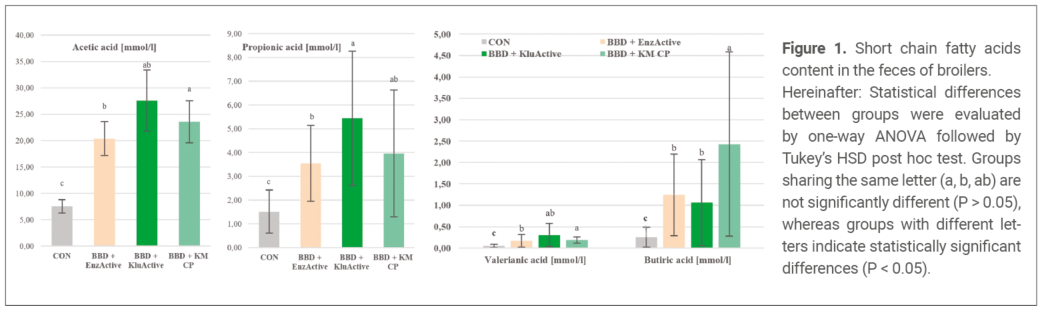
SCFAs, the main end products of carbohydrate fermentation, play a key role in intestinal physiology and metabolism. They provide energy for colonocytes and promote epithelial cell growth (29). Although the ability of Kluyveromyces marxianus to ferment substrates and produce acetate has been previously reported (30), the increase in the concentration of acetate is consistent with a yeast-mediated shift in the composition of the colonic microbiota.
The evaluation of bactericidal and lysozyme activities in broiler blood serum demonstrated that all probiotic treatments increased nonspecific humoral immunity compared with the control group. By day 14 of the trial, bactericidal activity in the probiotic-supplemented groups was higher (27.28–28.66%) than in the control (24.52%). This trend persisted on day 28, where bactericidal activity reached 34.00% in the S. cerevisiae group (BBD + EnzActive), 36.47% in the K. marxianus probiotic group and 36.16% in the commercial K. marxianus preparation group (BBD + KM CP), compared with 27.29% in the control (Figure 2).
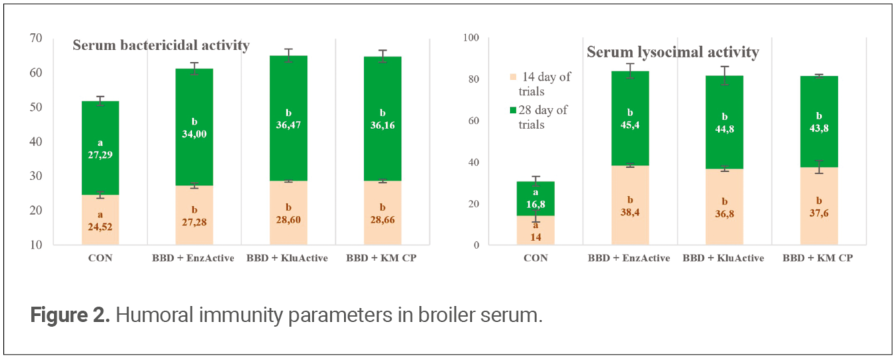
Supplementation with all probiotics resulted in higher bactericidal and lysozyme activities in broiler serum, indicating a stimulation of innate humoral defense mechanisms and improved early immune readiness.
According to Wang (31), K. marxianus supplementation benefits feed efficiency, immune function, and intestinal structure in broilers, which may be attributed to improvements in ileal microbial structure. High-dose supplementation (2.5 g/kg) of K. marxianus was more effective for feed efficiency and intestinal health, whereas innate immunity was optimized at a medium dose (1.0 g/kg).
The results demonstrate that supplementation with Kluyveromyces marxianus (both KluActive and KM CP) particularly enhanced phagocytic activity in broilers, with KluActive showing the most prominent effect (Figure 3).
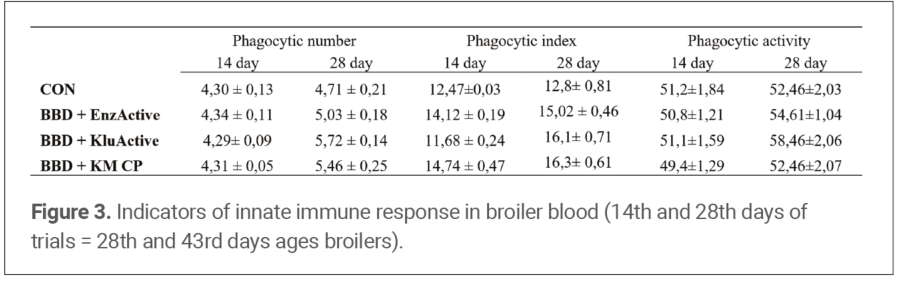
The increase in phagocytic index and activity in broilers treated with probiotics, especially with Kluyveromyces marxianus, aligns with findings from other studies that have shown probiotics to improve immune function in poultry.
Our results are consistent with the findings of Maccaferri with colleagues (32), which demonstrated that K. marxianus supplementation affects the colonic microbiota, increasing bifidobacterial concentration in stages of the colonic model system simulating the proximal and transverse colon. Additionally, short-chain fatty acid levels, such as acetate and propionate, increased following yeast supplementation. Yeast MOS and β-glucan can modulate specific and nonspecific immune responses. β-Glucans can activate phagocytes, which can stop or prevent bacterial infections and increase the antibody titer after vaccination (32). The anti-inflammatory effects of Kluyveromyces marxianus could be attributed to high β-glucan content and gut microbiota modulation (33). Finally, K. marxianus decreased the cytotoxic potential of the culture supernatant from the first stage of the colonic model system.
These effects on adhesion, immune function, and colonic microbiota indicate that strain possesses several beneficial and strain-specific properties, making it a promising candidate for development as a probiotic microorganism (34).
Conclusions
The Kluyveromyces marxianus-based probiotic demonstrated potential as a viable probiotic option in poultry supplementation. It produced the greatest increase in key short-chain fatty acids compared with the control group, indicating changes in gut microbial metabolism. At the same time, it enhanced innate immune markers, including serum bactericidal and lysozyme activities.
The observed improvements in microbiota function and immune responsiveness support the use of Kluyveromyces marxianus as a probiotic for supporting gut health and strengthening immune function in broilers — parameters associated with productive performance in poultry.
References and notes
- Nawaz A, Aslam M, Javed M, Kashif M, Ahmad T, Nadeem N. Poultry response to heat stress: mechanisms and mitigation through nutritional supplements. Front Vet Sci. 2021;8:699081. https://www.frontiersin.org/journals/veterinary-science/articles/10.3389/fvets.2021.699081/full.
- Oluwabunmi O, Deji A, Yewande O. Impact of Heat Stress on Broiler Chicken Production. Poultry. 2024;3(2):107–128. https://doi.org/10.3390/poultry3020010.
- Deleterious Effects of Heat Stress on Poultry Production: Unveiling the Benefits of Betaine and Polyphenols. Poultry. 2022 1(3):147-156 DOI:10.3390/poultry1030013
- Ricke SC. Potential of fructooligosaccharide prebiotics in alternative and nonconventional poultry production systems. Poult Sci. 2015;94:1411–8. https://doi.org/10.3382/ps/pev049
- Park SH, Hanning I, Perrota A, Bench BJ, Alm E, Ricke SC. Modifying the gastrointestinal ecology in alternatively raised poultry and the potential for molecular and metabolomic assessment. Poult Sci. 2013;92:546–61. https://doi.org/10.3382/ps.2012-02734
- Nahashon SN, Nakaue HS, Mirosh LW. Nutrient retention and production parameters of Single Comb White Leghorn layers fed diets with varying crude protein levels and supplemented with direct-fed microbials. Anim Feed Sci Technol. 1996;61:17–26. https://doi.org/10.1016/0377-8401(96)00956-X
- Gadde U, Kim WH, Oh ST, Lillehoj HS. Alternatives to antibiotics for maximizing growth performance and feed efficiency in poultry: A review. Anim Health Res Rev. 2017;18:26–45. DOI: 10.1017/S1466252316000207
- Idowu PA, Idowu AP, Zishiri OT, Mpofu TJ, Veldhuizen EJ, Nephawe KA. Activity of mannose-binding lectin on bacterial-infected chickens—a review. Animals. 2021;11:787. doi:10.3390/ani11030787
- Summers J, Turner B, Tillman N. Effects of feeding a probiotic blend on live performance of broiler chickens from 0 to 49 days of age. J Appl Poult Res. 2022;31:100273. doi:10.1016/j.japr.2022.100273
- Ishaq HM, Wagas I, Usman M, Ghayas A. Non-antibiotic growth promoters in poultry nutrition. Ann Anim Sci. 2025;25;4:. doi:10.2478/aoas-2025-0008
- Naeem M, Bourassa D. Probiotics in Poultry: Unlocking Productivity Through Microbiome Modulation and Gut Health. Microorganisms. 2025;13(2):257. doi:10.3390/microorganisms13020257
- Idowu, P. A., Mbambalala, L., & Idowu, A. P. (2025). Probiotics as sustainable alternatives to antibiotic growth promoters: Mechanisms, applications, and future perspectives in livestock production: Livestock health and productivity in the post-antibiotic era. Letters In Animal Biology, 5(1), 129-142.
- Yadav S, Jha R. Strategies to modulate the intestinal microbiota and their effects on nutrient utilization, performance, and health of poultry. J Anim Sci Biotechnol. 2019;10:1. doi:10.1186/s40104-018-0310-9
- Plaza-Diaz J, Ruiz-Ojeda FJ, Gil-Campos M, Gil A. Mechanisms of action of probiotics. Adv Nutr. 2019;10:S49–66. doi:10.1093/advances/nmy063
- Peter AI, Takalani JM, Takalani J, Mpofu Aletta M, Magoro, Aletta M. Magoro, Mamokoma C. Modiba, Mamokoma C. Modiba, Khathutshelo A. Nephawe, Khathutshelo A. Nephawe, Bohani M, Impact of probiotics on chicken gut microbiota, immunity, behavior, and productive performance—a systematic review. Front. Anim. Sci. 2025;6;16. https://doi.org/10.3389/fanim.2025.1562527
- Chen JF, Hsia KC, Kuo YW, Chen SH, Huang YY, Li CM, Hsu YC, Tsai SY, Ho HH. Safety Assessment and Probiotic Potential Comparison of Bifidobacterium longum subsp. infantis BLI-02, Lactobacillus plantarum LPL28, Lactobacillus acidophilus TYCA06, and Lactobacillus paracasei ET-66. Nutrients. 2024;16:126. DOI: 10.3390/nu16010126
- Buonanno A, Imparato M, Maione A, Carraturo F, Galdiero E, Guida M, de Alteriis E. The Biotherapeutic Potential of a Novel Probiotic Kluyveromyces marxianus Isolated from a Sourdough Starter Against Vaginal Candida albicans Strains. J Fungi. 2025;11:147. doi:10.3390/jof11020147
- Cox CM, Dalloul RA. Immunomodulatory role of probiotics in poultry and potential in ovo applications. Benef Microb. 2015;6:45 DOI: 10.3920/BM2014.0062
- Swaggerty CL, Callaway TR, Kogut MH, Piva A, Grilli E. Modulation of the immune response to improve health and reduce foodborne pathogens in poultry. Microorganisms. 2019;7:6 DOI: 10.3390/microorganisms7030065
- Rodjan P, Soisuwan K, Thongprajukaew K, Theapparat Y, Khongthong S, Jeenkeawpieam J, Salaeharae T. Effect of organic acids or probiotics alone or in combination on growth performance, nutrient digestibility, enzyme activities, intestinal morphology and gut microflora in broiler chickens. J Anim Physiol Anim Nutr. 2018;102:e931 DOI: 10.1111/jpn.12858
- Wu Y, Zhen W, Geng Y, Wang Z, Guo Y. Pretreatment with probiotic Enterococcus faecium NCIMB 11181 ameliorates necrotic enteritis-induced intestinal barrier injury in broiler chickens. Sci Rep. 2019;9:10217
- Matiukha I, Krasovska O, Vishchur O, Broda N, Mudrak D, Romanko M, Ushkalov V. Effectiveness of yeast probiotics in implementing the “no antibiotics ever” strategy in broiler farming. Bulgarian J Vet Med. 2025;ISSN 1311-1477; doi:10.15547/bjvm.2025-0014
- Martin E, Bhakdi S. Flow cytometric assay for quantifying opsonophagocytosis and killing of Staphylococcus aureus by peripheral blood leukocytes. J Clin Microbiol. 1992;30(9):2246–55. DOI: 10.1128/jcm.30.9.2246-2255.1992
- Zielińska M, Fenrych W. The application of a flow cytometric assay for evaluation of phagocytosis of neutrophils. Acta Biochim Pol. 1997;44(1):1–8.
- Hahne M, et al. Quantification of phagocytosis in human neutrophils by flow cytometry. Clin Diagn Lab Immunol. 1999;6(4):540–6.
- Dorofeichuk VG. Methods for determining lysozyme activity in biological fluids. Kyiv: Institute of Microbiology and Virology; 1968.
- Necchi F, Saul A, Rondini S. Development of a high-throughput method to evaluate serum bactericidal activity using bacterial ATP measurement as survival readout. PLoS One. 2017 Feb 13;12(2):e0172163. doi: 10.1371/journal.pone.0172163. PMID: 28192483; PMCID: PMC5305226.
- Zhang S, Kim H, Milenković D, et al. Gas chromatography–mass spectrometry‑based analyses of fecal short-chain fatty acids (SCFAs): a summary review and own experience. Biomedicines. 2019;7(4):72.
- Jacobs DM, Gaudier E, van Duynhoven J, and Vaughan EE. Non-digestible food ingredients, colonic microbiota and the impact on gut health and immunity: a role for metabolomics. Curr. Drug Metab. 2009;10:41–54. DOI: 10.2174/138920009787048383
- Fonseca GG, Gombert AK, Heinzle E, Wittmann C. Physiology of the yeast Kluyveromyces marxianus during batch and chemostat cultures with glucose as the sole carbon source. FEMS Yeast Res. 2007;7:422–435. https://pubmed.ncbi.nlm.nih.gov/19149512/

Peer-reviewed – Development of Plant-Based Sodium Alginate-Aloe...

From Soil Health to Business Resilience: Why Sustainability is no Long...

Complete Gut Health Solutions One Ecosystem. Seven Science-Led Strateg...
Peer-reviewed – Prebiotic Efficacy of a Fiber-Polyphenol Complex...

The Blueprint – How Functional Ingredients Pioneered the Digital...

A Word With – Reyhan Nergiz Unal and Yingying Wu – PB Leiner

A Word With – Shaheen Majeed – CEO & Managing Director, Sab...

Peer-reviewed – Cellular Health Powering Fertility: Mitochondria...