

Innovation in the food sector depends on more than promising ideas. It requires robust scientific evidence demonstrating safety, nutritional relevance, and real-world applicability. From novel ingredients and processing technologies to evolving risk assessment frameworks, translating scientific advances into real-world application demands collaboration across disciplines and sectors.
Through its pre-competitive model, ILSI Europe brings together scientists from industry, academia and the public sector to address these shared scientific questions. The activities highlighted in this column illustrate how collaborative science helps build the evidence needed to support food and nutrition innovation. They span assessing new ingredients, ensuring microbiological safety, strengthening nutritional biomarkers and fostering scientific exchange on emerging challenges.
Assessing plant-based proteins for infant nutrition
Consumer interest in plant-based nutrition continues to grow, including in early-life nutrition. However, infant formula remains one of the most strictly regulated food categories, where innovation must be supported by robust evidence of nutritional adequacy, safety, and suitability for infant development.
To help identify both the opportunities and remaining scientific hurdles, the ILSI Europe’s Early Nutrition & Long-Term Health Task Force (1) brought together specialists in nutrition, food science and clinical practice for an expert workshop back in November 2024. Considering sustainability, sourcing & processing, and nutrition & health, they reviewed established protein sources such as soy and hydrolysed rice, as well as emerging candidates like pea, lentil, and faba bean proteins.
The review highlights that significant scientific gaps remain and that no evidence currently supports full nutritional equivalence with dairy proteins (2). Key uncertainties relate to amino acid profiles, digestibility, allergenicity, and long-term safety in infants. Nevertheless, the workshop identified clear reasons for continued research—not as a shift toward any specific ingredient category, but to support evidence-based product development and ensure that future innovations meet the high standards expected for infant nutrition. Priorities include improving protein extraction methods, advancing in vitro digestion and allergy models, and conducting targeted clinical studies to confirm growth and developmental outcomes.
Ensuring microbiological safety in novel and minimally processed foods
Innovation does not stop at demonstrating nutritional adequacy. As new ingredients and minimally processed foods enter the market, ensuring their safety is equally important. This is particularly relevant for minimally processed and novel plant-based foods, which often present different microbiological characteristics than their conventional counterparts.
Spore-forming bacteria such as Bacillus and Clostridium species represent a persistent challenge. Their spores can survive heat treatments like pasteurisation, leading to spoilage or safety risks. ILSI Europe’s Microbiological Food Safety Task Force (3) is addressing this through a new activity aimed at developing guidance on when and why these microorganisms are of concern. The work will distinguish between pathogenic, spoilage, and beneficial species, and assess the relative contribution of raw materials and processing steps to contamination risks.
The increasing use of plant-based ingredients is a key driver, as these foods may present higher initial spore loads and are often less compatible with severe heat treatments. The expert group commissioned for this activity will develop a narrative review of food–microorganism interactions, identify data gaps in novel food categories, and propose risk-based mitigation strategies tailored to different food types.
Strengthening the scientific foundations of vitamin K nutrition
Responsible innovation also depends on measuring nutritional effects accurately. Yet for many nutrients, no single biomarker provides a complete picture. Under its Vitamin K2 Task Force (4), ILSI Europe is launching a new activity to evaluate existing and emerging biomarkers of vitamin K status. The aim is to assess their validity, sensitivity, and practical applicability in research and clinical contexts.
Since the last comprehensive review on the topic (5), the field has expanded with new biomarkers, improved analytical methods, and additional clinical evidence. However, challenges remain in distinguishing hepatic and extra-hepatic functions, linking biomarkers to intake and bioavailability, and assessing responses to supplementation.
A key objective is to determine when combinations of biomarkers, supported by dietary data, are needed for more accurate assessment. The work will also identify research gaps, particularly regarding clinical application. By improving consistency in biomarker use and interpretation, this initiative aims to strengthen future nutrition research and support more comparable intervention studies, helping generate evidence that can inform product development and regulatory discussions.
”Have a hypothesis, not a religion”
Beyond individual projects, collaborative science also depends on structured spaces for exchange, reflection, and forward-looking dialogue. In June 2026, 150 delegates from academia, industry, and the public sector gathered in Brussels to mark 40 years of connection. The ILSI Europe Symposium 2026 (6) combined nutrition and food safety sessions, showcasing ongoing Task Forces activities and highlighting emerging scientific priorities.
The opening keynote by independent nutrition scientist Dr David Mela (7) focused on scientific integrity in an evolving research landscape. Encouraging scientists in the room to “have a hypothesis, not a religion”, he challenged them to recognise their own biases and warned against scientific “zombies”—ideas that persist despite contradictory evidence—and “zebras”—findings that gain traction because weaker evidence is favoured to fit prior assumptions or interests (8).
In the closing lecture, applied futurist Tom Cheesewright (9) explored the societal and technological forces likely to reshape the food sector. For example, the combined effects of the obesity crisis and an ageing population could drive more far-reaching regulatory changes as governments respond to mounting public health pressures. His presentation invited participants to consider how today’s research priorities can prepare the sector for tomorrow’s challenges.
The ILSI Europe community will meet again and continue these conversations on emerging research ideas. For the next edition of ILSI Europe Symposium (21 April 2027, Bologna, Italy) a call for abstracts will open shortly to academic and industry scientists. Save the date!
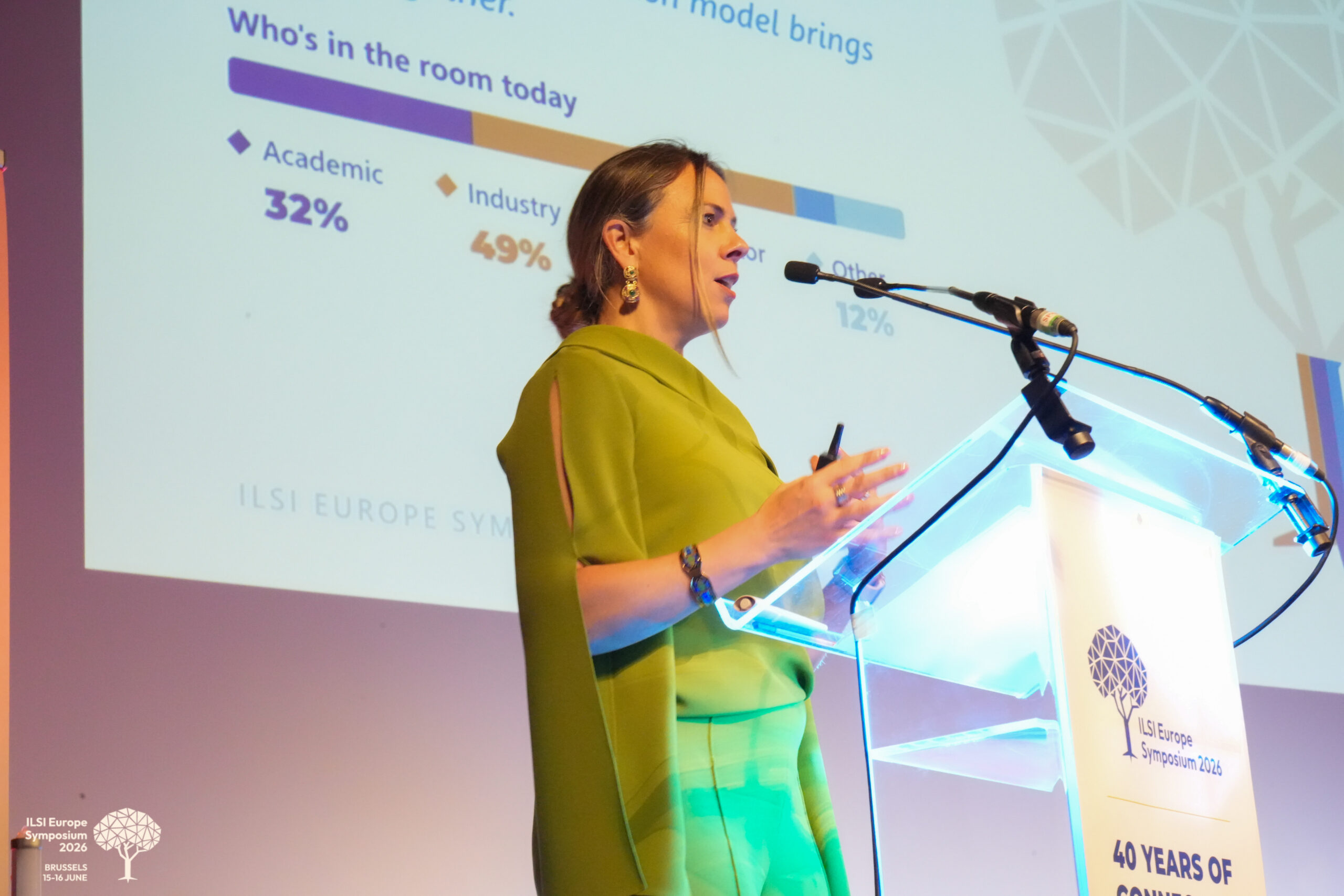
150 delegates joined the ILSI Europe Symposium 2026 in Brussels, welcomed here by Executive Director, Isabelle Guelinckx.
Stronger science, together
Responsible innovation depends on robust, shared evidence. By bringing together industry, academia and the public sector in pre-competitive dialogue, ILSI Europe helps transform emerging scientific questions into robust evidence that supports safe, effective and trusted innovation across the food sector.
References and notes
- ILSI Europe Early Nutrition & Long-Term Health Task Force, https://ilsi.eu/scientific-activities/nutrition/early-nutrition-and-long-term-health/
- Hettinga KA, et al. Plant-based proteins for infant formula: findings and recommendations from the ILSI Europe workshop. Front Nutr. 2025;12:1677243. doi:10.3389/fnut.2025.1677243
- ILSI Europe Microbiological Food Safety Task Force, https://ilsi.eu/scientific-activities/food-safety/microbiological-food-safety/
- ILSI Europe Vitamin K2 Task Force, https://ilsi.eu/scientific-activities/nutrition/vitamink2/
- Shea MK, Booth SL. Concepts and controversies in evaluating vitamin K status in population-based studies. Nutrients. 2016;8(1):8. doi:10.3390/nu8010008
- ILSI Europe Symposium 2026, Brussels, 15-16 June 2026, https://ilsieuropesymposium.eu/
- https://djmela.eu/
- Mela DJ. The defamation of low-energy sweeteners: crop circles, zombies, and zebras. OSF Preprints; 2022. Available from: https://osf.io/nh6ay
- https://tomcheesewright.com/

The Anatomy of a Paradox and a Need for Real-World Evidence

The timeless skin revolution: how Indena’s botanical innovations...

PEER REVIEWED – New evidence supports plant-based sources in clo...

How GLP-1 is reshaping food supplements

Beyond Longevity: the new frontier of healthy aging with full spectrum...

The Blueprint — How Functional Ingredients Pioneered the Digital Decen...

Probiotic Human Study Design and Reporting (PRODARE): improving probio...

PEER REVIEWED – Acute postprandial gastrointestinal symptom reli...


