

For decades, the clinical research enterprise operated on the implicit assumption that science required participants to travel to a research site. Clinics, with their trained study staff and standardized procedures, were long considered the only option. Yet this model created a structural bottleneck, as asking participants to navigate rigid schedules and absorb travel burdens constrained recruitment. Furthermore, strict inclusion and exclusion criteria, designed to maximize internal validity, narrowed eligibility. Consequently, studies often under-enrolled and struggled to predict how well findings would translate to real-world settings.
To address these systemic inefficiencies and expand research accessibility, the industry has increasingly pivoted toward a participant-centric framework, paving the way for decentralized clinical trials (DCTs). DCTs conduct some or all research activities outside traditional sites, bringing the study to the participant’s home, community, or daily environment. By integrating digital platforms, wearables, remote monitoring, and at-home sample collection, DCTs generate rigorous evidence while removing long-standing access barriers. This approach, designed to meet people where they live, promises broader, more diverse participation and greater operational efficiency.
A Concept That Preceded the Technology
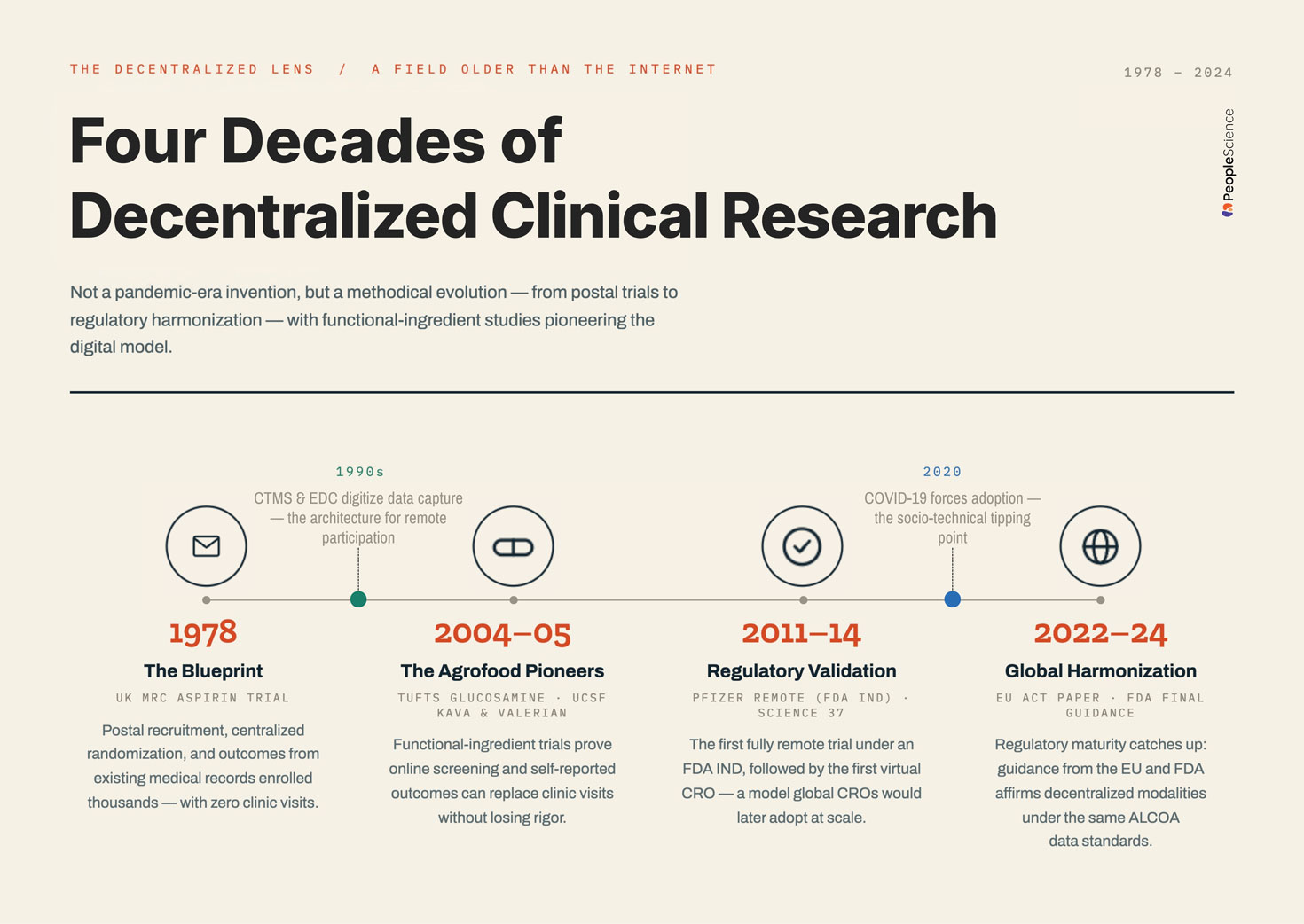
It may be surprising to know that decentralized research emerged before broadband internet. The 1978 UK Medical Research Council Aspirin Trial demonstrated that meaningful clinical research could be conducted at scale without a single clinic visit (1). By leveraging postal recruitment, centralized computer-generated randomization, and outcome measures through existing medical records, it enrolled thousands of participants while bypassing the research site entirely. This was ahead of its time, both methodologically and philosophically.
The groundwork for digitally-enabled DCTs began taking shape in the 1990s with the advent of Clinical Trial Management Systems (CTMS) and Electronic Data Capture (EDC) tools. These innovations digitized data collection that had previously relied on manual transcription and paper case report forms. Beyond efficiency gains, they established the technical architecture necessary for remote participation.
How Functional Ingredients Pioneered the Digital DCT
Notably for the agrofood sector, clinical trials evaluating dietary supplements in the early 2000s provided the first clear evidence that digital tools could replace clinic visits without compromising scientific rigor. A 2004 glucosamine study for osteoarthritis, conducted at Tufts-New England Medical Center (2), enrolled participants via online screening, with symptom-based subjective outcomes serving as the primary endpoint. Eligibility was confirmed through medical record review, eliminating the need for any in-person clinic visit. A 2005 internet-based trial of kava and valerian for anxiety and insomnia at the University of California San Francisco (3) went further, as eligibility was determined entirely by self-reported scores on validated symptom questionnaires administered online. Together, they established a foundational principle: where subjective outcomes, such as pain or anxiety, are clinically meaningful, the participant’s real-world naturalistic setting is a key benefit.
Crossing the Regulatory Threshold
These early ingredient studies operated in regulatory ambiguity. A decisive signal came in 2011 with Pfizer’s REMOTE trial (4), the first web-based, randomized, placebo-controlled Phase 4 study conducted under a US Food and Drug Administration (FDA) Investigational New Drug (IND) application. For the first time, a regulatory authority had accepted the framework of a fully remote trial. In 2014, Science 37 was founded as the first virtual Contract Research Organization (CRO) that established a technology-enabled end-to-end service model that global CROs would later adopt at scale.
Operational Challenges and Solutions
Innovation adoption is rarely frictionless. Regulatory-grade clinical assessments, such as validated scales and patient-reported outcome instruments engineered to precise paper formatting standards, lacked digital equivalents with the equivalence evidence regulators expected. Migrating them to mobile platforms typically necessitated cognitive debriefing studies and equivalence testing to demonstrate that format changes had not altered how participants interpreted and responded to items. Clinician-reported outcomes dependent on in-person visual assessment required new protocols for remote administration. Identity verification required solutions the field had not previously needed, including consumer database services and telehealth video visits, drawing on tools already mature in the consumer technology sector.
Each of these was a solvable technical problem. What proved more transformative was a conceptual one: design the participant experience the way consumer products are designed, by mapping the individual journey and systematically eliminating friction from recruitment through final data collection. The role of fit-for-purpose design in DCT platform success is a topic we will return to later in this series.
When Infrastructure Met Its Moment
The COVID-19 pandemic catalyzed a socio-technical tipping point toward broader application. Today, regulatory maturation has caught up with the technology. The FDA’s 2024 guidance on decentralized elements (5), alongside the European Union’s 2022 recommendation paper developed under the Accelerating Clinical Trials in the EU initiative (6), signals growing regulatory acceptance of modern approaches to evidence generation.
For European researchers aiming for European Food Safety Authority health claims, these guidelines explicitly confirm that existing data quality and integrity requirements apply equally to decentralized modalities. The foundational ALCOA principles (requiring data to be attributable, legible, contemporaneous, original, and accurate) remain non-negotiable. Grounding new remote evidence-generation infrastructures in these principles ensures they earn their place within established systems of scientific accountability.
Where We Stand Today: The Food-Tech Opportunity
The evolution toward hybrid designs reflects a pragmatic convergence. For agrofood sponsors, participant convenience should be the default starting point of protocol design. Where time-sensitive biosampling (such as stool samples for microbiome profiling), specialized equipment, or complex procedures require a clinic presence, hybrid protocols preserve that capacity while removing unnecessary burden elsewhere.
Reframing the participant as an empowered stakeholder has driven higher engagement, better data compliance, and lower attrition.
This shift meets a broader cultural moment: a generation of consumers who already track their sleep, blood glucose, and activity through consumer wearables. In gut health, brain health, cognitive performance, and healthy aging research, real-world evidence matters. These are conditions where attending a research site can itself disrupt an individual’s natural behaviors, circadian rhythms, and dietary responses the study is trying to capture.
The economic landscape remains nuanced, as logistics like mobile nursing and at-home sampling introduce new costs. However, for companies where time-to-market is a strategic priority, the acceleration of enrollment and study timelines offers a significant return on investment.
What Comes Next
The story of decentralized clinical research is still unfolding. Future articles will address regulatory harmonization across the US, EU, and other global jurisdictions, and examine how these frameworks influence sponsor strategy. We will also explore how DCT infrastructure facilitates n-of-1 research and personalized evidence generation, blurring the line between clinical research and daily care as we redefine our understanding of health.
References and notes
- Peto R, et al. Randomised trial of prophylactic daily aspirin in British male doctors. BMJ. 1988;296(6618):313–6. https://www.bmj.com/content/296/6618/313
- McAllindon TE, et al. Effectiveness of glucosamine for symptoms of knee osteoarthritis: results from an internet-based randomized double-blind controlled trial. Am J Med. 2004;117(9):643–9. https://www.amjmed.com/article/S0002-9343(04)00477-2/pdf
- Jacobs P, et al. An internet-based randomized, placebo-controlled trial of kava and valerian for anxiety and insomnia. Medicine (Baltimore) 2005;84(4):197-207. https://pubmed.ncbi.nlm.nih.gov/16010204/
- Orri M, Lipset CH, Jacobs BP, Costello AJ, Cummings SR. Web-based trial to evaluate the efficacy and safety of tolterodine ER 4mg in participants with overactive bladder: REMOTE trial. Contemp Clin Trials 2014;38(2)190-7. https://pubmed.ncbi.nlm.nih.gov/24792229/
- https://www.fda.gov/regulatory-information/search-fda-guidance-documents/conducting-clinical-trials-decentralized-elements
- https://health.ec.europa.eu/system/files/2023-03/mp_decentralised-elements_clinical-trials_rec_en.pdf

The Anatomy of a Paradox and a Need for Real-World Evidence

The timeless skin revolution: how Indena’s botanical innovations...

PEER REVIEWED – New evidence supports plant-based sources in clo...

How GLP-1 is reshaping food supplements

Beyond Longevity: the new frontier of healthy aging with full spectrum...

Probiotic Human Study Design and Reporting (PRODARE): improving probio...

PEER REVIEWED – Acute postprandial gastrointestinal symptom reli...

Insights from the 19th International Scientific Conference on Probioti...


